China’s Humanoid Robots Shine Globally as Embodied Intelligence Enters Application Era
Since the start of 2026, China’s independently developed humanoid robots have frequently gained widespread attention, from the Consumer Electronics Show (CES) in Las Vegas, USA, to China’s Spring Festival Gala. Products and applications from multiple Chinese enterprises have not only sparked heated discussions in the overseas industry but also gone viral on global social media platforms and in international media, reflecting the accelerated arrival of the embodied intelligence application era.
This phenomenon confirms the industry’s general view: at this critical juncture of technological breakthroughs and industrial restructuring, artificial intelligence (AI) is integrating into the physical world through carriers, with embodied intelligence accelerating its entry into the application phase. China, boasting advantages such as strong policy support, accelerated technological innovation, improved industrial chains and abundant application scenarios, is becoming a key driving force behind this cutting-edge global industrial transformation.
Embodied intelligence, which follows a similar logic to human intelligence—interactions between the brain, body and environment—emphasizes not only the computing power support of the AI "brain" but also integration with physical entities, serving as an intelligent agent capable of integrated perception, cognition, decision-making and action. Humanoid robots, regarded as its optimal form, are expected to become the next generation of super terminals after smartphones and new energy vehicles.
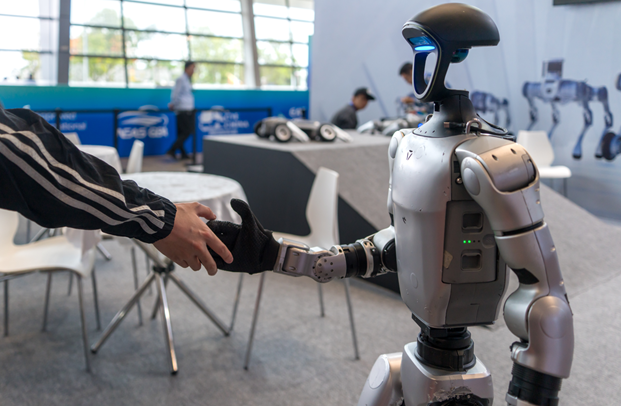
Reports from international institutions have highlighted this trend. A February report by the World Economic Forum noted that the mid-2020s may be remembered as a period when AI evolved from a screen-based productivity tool to a physical system operating in the real economy. A separate report from Georgetown University’s Center for Security and Emerging Technology pointed out that while global attention has focused on generative AI and chatbots over the past three years, a quieter transformation—the arrival of physical AI—is underway.
The shift from laboratory demonstrations to large-scale commercial deployment is widely regarded as the primary trend in embodied intelligence development this year. Deloitte’s latest 2026 Technology Trends Report states that physical AI is ready for mainstream deployment, while the World Economic Forum noted that embodied intelligence began transitioning from the research phase to industrial application in early 2026.
Quantitative data reflects robust market growth: the global embodied intelligence market reached approximately 4.44 billion US dollars in 2025, with a compound annual growth rate of about 39%, and is expected to hit 23 billion US dollars by 2030, according to a report from international market research firm M&M. Nvidia’s founder and CEO Jensen Huang noted in his CES speech this year that AI will evolve from perception and generation to physical AI capable of understanding the physical world, predicting its "ChatGPT moment" is imminent.
Nevertheless, emerging technologies take time to mature. Currently, embodied intelligence still faces challenges such as immature robot large models and a lack of high-quality AI training data, with its technological routes, commercial models and application scenarios yet to be fully refined. It remains in its initial stage, and a major breakthrough in large models and robot technology could drive a boom surpassing the mobile internet era.
Chinese enterprises have made remarkable progress in this field, with their humanoid robots gaining popularity for applications ranging from autonomous operations at CES to stage performances during the Spring Festival Gala, as well as securing industrial orders and pioneering rental models. Many scholars and entrepreneurs, including Elon Musk, have acknowledged China’s strong strength in this sector, which stems from sustained policy support and industrial investment.
Embodied intelligence was first included in China’s government work report in 2025, and cities such as Beijing, Shanghai and Shenzhen have launched a series of measures, including 100-billion-level industrial funds, to promote core technological research. The State Council Development Research Center predicts China’s embodied intelligence market will exceed 1 trillion yuan by 2035.
International Data Corporation (IDC) data shows that humanoid robots entered large-scale commercial use in 2025, with global shipments reaching about 18,000 units, of which China accounted for the main share. European and American media have marveled at China’s technological innovation speed, recognizing its role as a key driver of the global embodied intelligence industry. Its vigorous development is expected to boost new productive forces in multiple sectors and bring more convenience to people’s lives.