China’s Urban Water Environment Governance Shifts Towards Resource Recycling Amid Green Transition
As China’s urbanization process continues to deepen, urban water environment governance has become a key focus of comprehensive green transition and a vital project related to people’s livelihood. This year’s Government Work Report proposes to "accelerate the comprehensive green transition", raising questions about the future direction of the urban water environment governance sector, new opportunities brought by new policies, and replicable practical experiences. Recently, the chairman of China Water Environment Group shared insights into industry development, market opportunities and practical practices, combining the enterprise’s operational experience.
He noted that the Government Work Report has elevated "comprehensive green transition" to a new strategic height, specifically clarifying that carbon peaking and carbon neutrality should be taken as the guide to coordinate decarbonization, pollution reduction, green expansion and growth. This requires the water environment governance industry to move beyond the traditional "end-of-pipe treatment" mindset and shift towards full-life-cycle "resource management". The coordination of the four goals means a transformation from "treating pollution to meet discharge standards" to "recycling resources".
Urban sewage, he emphasized, is not a pollutant but a stable secondary water resource and secondary green energy. Through the independently developed "distributed sinking reclaimed water ecological system", the enterprise has promoted the transformation of traditional sewage treatment plants into urban green "new infrastructure" integrating water resources, green energy, data information, public service supply and comprehensive space utilization, realizing the coordinated improvement of pollutant reduction and carbon emission control, and converting ecological value into development momentum.
Regarding the new deployment of "accelerating the construction of a Beautiful China and promoting green and low-carbon development" as well as the launch of "Beautiful China Pilot Zone Construction", he pointed out that the focus of ecological protection during the 15th Five-Year Plan period will upgrade from the "tough battle against pollution" to the systematic construction of "Beautiful China", with the pilot zone construction serving as a key starting point for the opening of the 15th Five-Year Plan.
The construction of pilot zones will inevitably require higher environmental quality. At present, municipal water treatment facilities are moving from "scale expansion" to "quality improvement and system optimization", which has spawned huge demand for the renewal and transformation of existing facilities, especially the "integrated plant-network" global governance and intelligent operation and maintenance. The Action Plan for the Construction of the Beautiful China Pilot Zone in the Beijing-Tianjin-Hebei Region clearly proposes building a pilot zone for green and low-carbon transition and forming a number of collaborative innovation models for urban pollution reduction and carbon reduction.
Taking the group’s Beijing Bishui Reclaimed Water Plant as an example, it was selected as one of the first batch of "green and low-carbon benchmark sewage treatment plants" jointly announced by the National Development and Reform Commission and the Ministry of Housing and Urban-Rural Development in 2024, supporting the construction of a national green development demonstration zone with new-quality productive forces and providing practical experience for the industry. With the advancement of the Beautiful China Pilot Zone Construction, advanced technical solutions for energy conservation, carbon reduction and resource recovery in sewage treatment will be promoted and implemented at an accelerated pace.
When talking about the integrated development of water environment governance and urban renewal in megacities, he said that the core contradiction in megacity water environment governance lies in the balance between "space" and "function". In the prime urban areas where land is extremely valuable, the key is to make sewage treatment facilities exert environmental benefits while releasing land value.
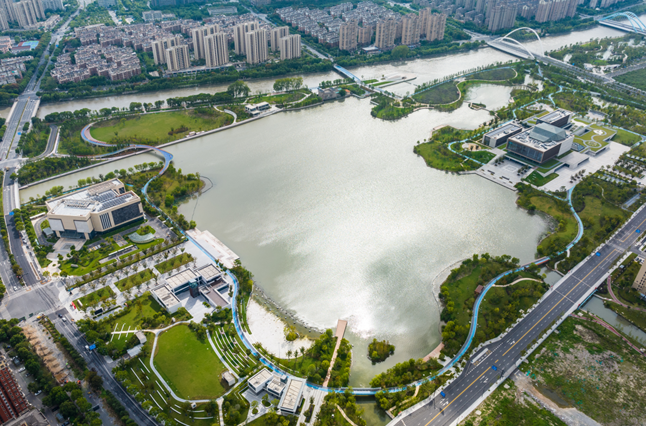
The Beijing Bishui Reclaimed Water Plant, again taken as an example, is an underground sewage plant realizing "in-situ reconstruction and expansion without stopping production" in the built-up area of a megacity, with a treatment capacity of 180,000 tons per day. Adopting the "distributed sinking reclaimed water system" technology, the originally NIMBY (Not In My Backyard) above-ground plant was entirely moved underground, and an ecological park was built on the ground. This not only completely solved the problems of odor and noise but also released about 150 mu of scarce land resources for the city, reserving environmental space for the development of the Beijing Urban Sub-Center.
The development of such "urban secondary water sources" not only eases the water shortage pressure in northern cities but also promotes the coordinated advancement of "decarbonization, pollution reduction, green expansion and growth" through reclaimed water reuse, water source heat pump heating and ground carbon sink construction, helping megacities build a more intensive, safe and resilient water system.