Shanxi Delivers Strong Results From Agricultural Pollution Remediation Across Yellow River Basin Counties
According to regional agricultural news outlets, a string of agricultural non-point source pollution control schemes launched across Shanxi Province have reached key delivery milestones, forming robust technical and institutional frameworks to advance eco-friendly farming, rural revitalisation and high-quality development along the Yellow River basin.
After its comprehensive acceptance inspection in May 2024, the agricultural pollution abatement project in Hejin City has delivered measurable environmental improvements. The local straw comprehensive utilisation rate stands above 95%, while the recycling and treatment rate for livestock and poultry manure exceeds 90%. Chemical oxygen demand discharges have been cut by 40%, alongside a 30% reduction in total nitrogen emissions and a fall of more than 30% in total phosphorus outputs.
Across Shanxi, authorities have rolled out coordinated action covering policy layout, institutional refinement and technical research, with county-level integrated remediation as the core operational approach. Multiple flagship schemes in Wuxiang, Fenxi and Hejin have demonstrated replicable management and technical models for agricultural ecological governance.
Wuxiang County builds four-party collaborative mechanism for streamlined project delivery
Construction work on Wuxiang County’s Yellow River basin agricultural pollution remediation project remains in full swing amid the Dragon Boat Festival holiday. The scheme carries a total investment exceeding 100 million yuan and covers five core treatment segments, including resource recovery of livestock waste, full straw utilisation and targeted reduction of chemical fertilisers and pesticides. Overall construction progress has surpassed 97%, with full completion scheduled in the near term.

Agricultural governance projects feature scattered sub-projects, numerous executing parties and complex cross-domain coordination demands. To address such operational hurdles, Wuxiang County has introduced full-process professional consultancy services and established a four-tier collaborative management framework. The system divides clear responsibilities across supervisory authorities, centralised consultancy teams, on-site engineering supervisors and construction contractors, delivering closed-loop standardised oversight covering every phase, segment and element of development.
Consultancy teams carry out unified scheduling over core workflows including construction timetables, equipment procurement and installation, sequencing of engineering works and archiving of project documentation. Coordinated scheduling across the five core treatment segments smooths handovers between overlapping works and eliminates uneven delivery speeds for individual sub-projects, creating synchronised, county-wide integrated progress.
A parallel working protocol mandates complete documentation updates concurrent with physical construction. Dedicated staff maintain real-time records covering construction ledgers, testing reports, contractual invoices and acceptance paperwork throughout the build cycle. Real-time data filing removes risks of late backfilling, inconsistent ledgers and factual errors, laying solid archival foundations for subsequent inspection, asset registration and long-term maintenance.
Routine supervision visits led by county agricultural departments, centralised planning from consultancy bodies, permanent on-site supervisors and tight milestone adherence from contractors combine to embed full accountability over construction timelines, build quality and site safety, forming an efficient, unified delivery ecosystem.
Fenxi County deploys customised low-cost technologies for livestock waste recycling
Fenxi County’s key basin pollution control project commands total investment above 100 million yuan. Central government budget allocations contribute 50 million yuan, with local fiscal funds and project operating enterprises providing a further combined sum of over 52 million yuan. Corporate self-raised capital accounts for 43.3254 million yuan, equivalent to 42.12% of overall investment. Five core development strands are incorporated, centred on livestock manure resource recovery and crop straw comprehensive processing.
As a major livestock rearing hub, Fenxi County has tailored bespoke waste management blueprints for its 11 large-scale breeding facilities. Each facility’s solution aligns with its livestock varieties, breeding scale, existing hardware and operational challenges, removing inefficiencies from blanket standardised treatment systems. Four context-appropriate technical models have been deployed to lift overall pollution abatement performance.
One beef cattle enterprise operates a combined trough aerobic composting and black membrane anaerobic fermentation workflow. Solid waste undergoes pre-mixing, trough turning fermentation and ageing before conversion into organic fertiliser. Liquid effluent enters covered anaerobic tanks for a minimum 120-day fermentation cycle; diluted biogas slurry returns directly to farmland, while desulphurised biogas undergoes flared combustion. The closed ecological loop – livestock waste converted to organic fertiliser, applied to farmland to grow forage for cattle rearing – offers a replicable template for large-scale beef operations.
A local farming cooperative housing a designed herd of 1,000 beef cattle generates over 7,300 tonnes of manure annually, alongside collected waste from surrounding breeding sites and managed farmland spanning more than 300 mu. The facility uses nano-film aerobic composting technology. Manure blends with straw additives to adjust moisture content below 65%, before sealed aerobic fermentation over 15 to 20 days under nano-membrane cover. High internal temperatures eliminate pest eggs and weed seeds while trapping odour emissions. Aged composted material is spread back onto farmland via three-stage fertiliser spreaders, with power costs held at merely two yuan per tonne of treated waste. The model delivers minimal upfront capital outlay and low daily running expenses, suitable for small and medium-scale breeders and integrated straw-waste processing operators.
A poultry farming firm in the county relies on vertical high-temperature aerobic fermentation tanks. Chicken manure transfers via conveyor belts into sealed tanks, mixed with microbial agents and fermented at sustained temperatures of 60 to 70°C for seven to ten days for rapid hazard elimination. The compact, fully automated sealed tanks cut land usage and suppress odour release, forming a transferable technical blueprint for layer and broiler breeding operations countywide.
Hejin City develops multi-dimensional governance matrix for circular agricultural systems
Launched in 2021, Hejin City’s Yellow River basin agricultural pollution remediation project drew investment close to 82 million yuan across 19 sub-projects delivered by 16 implementing entities. Formal completion and acceptance on 16 May 2024 brought into operation a fully integrated governance matrix defined by intensive crop and livestock production, clean farming workflows, circular waste processing and digital monitoring infrastructure.
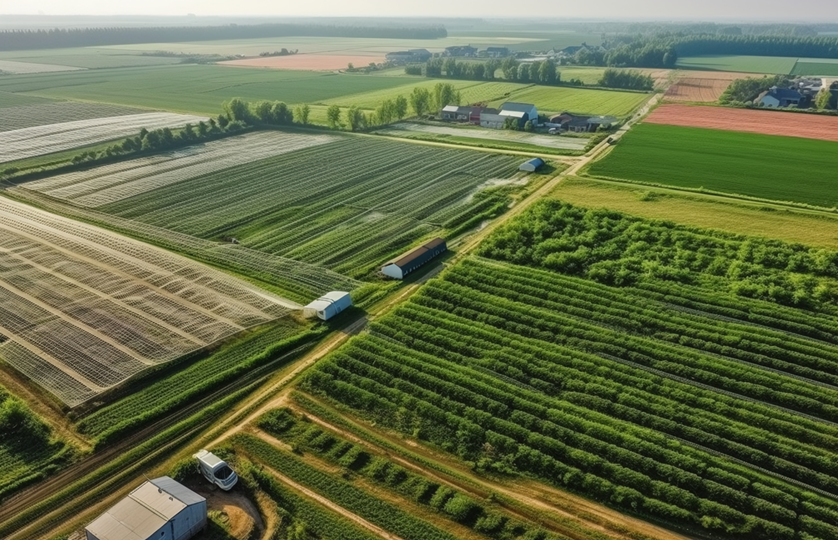
A 60,000-mu core demonstration zone on Yellow River tidal flats hosts 2,973 solar suction insect traps, installed at a density of one unit per 20 mu. Over a single operational year in 2025, the traps eliminated hundreds of millions of crop pests and suppressed pest reproduction cycles, delivering consistent year-on-year falls in pest populations and supporting sustained cuts in chemical fertiliser and pesticide usage.
Livestock waste management follows source reduction workflows utilising dry manure collection and high-pressure washing systems. Farm wastewater flows via gravity drainage to collection wells, undergoing solid-liquid separation before transfer to anaerobic digesters to produce liquid organic fertiliser for surrounding farmland. Regularly extracted digestate matures for field application. Crop straw acts as a complementary processing additive during waste treatment, enabling simultaneous handling of livestock manure and agricultural plant residues.
Since project completion, straw now supplies more than 60% of ruminant livestock forage supplies. Whole-crop corn silage processing elevates forage nutritional value and utilisation rates, cutting breeding expenditure, boosting meat output, shortening livestock fattening cycles and lowering disease incidence. Local farm soil structure sees consistent improvement alongside rising crop yields, sustaining a self-reinforcing ecological loop linking cattle breeding, manure processing, arable land cultivation and forage production.
An integrated recovery network for waste agricultural film and irrigation tubing spans eight township-level collection stations, one central storage hub and one dedicated recycling facility. Local collection outlets deliver recovered plastic waste to the storage hub for baling, with consolidated consignments forwarded to the recycling centre for reprocessing. Third-party operators manage downstream reprocessing work, purchasing discarded film and irrigation tubing at a fixed rate of 2.4 yuan per kilogram. Repurposed material forms new irrigation tubing, with operators providing low-cost laying services, free tube extraction and full take-back arrangements to complete the end-to-end waste recovery chain.
Hejin’s long-term remediation work has delivered near-total utilisation of crop straw resources. Pesticide application volumes in tidal flat treatment zones have dropped by over 20%. Produce from core demonstration zones complies fully with national food safety and agricultural product quality standards, while market supply of green, organic and pollution-free farm goods continues to expand.
All key agricultural non-point source pollution control schemes initiated during Shanxi’s 14th Five-Year Plan period advance at full operational pace. Two county-level projects launched in late 2025 will reach completion by the end of the current calendar year, with all remaining county schemes substantially finished ahead of a province-wide unified acceptance window in August. The suite of interventions establishes robust environmental safeguards supporting green agricultural development throughout the Yellow River basin.