New Bio-organic Fertiliser Delivers Over 20 Per Cent Wheat Yield Rise on Saline-Alkali Farmland in Hebei
According to Xinhua News Agency and Hebei Daily Online reports, full yield harvesting and standardised field assessment work has recently concluded on wheat plots at Beige Village, Litianmu Town, Cang County, Hebei Province. A specialist technical panel completed systematic field testing on trial land treated with innovative bio-organic fertiliser, with final measured outputs recording a production uplift exceeding one fifth against plots managed under conventional chemical fertiliser regimes. The treatment also delivers sustained remediation of saline-alkali topsoil, creating a low-cost, replicable production model for farming households operating across extensive saline land zones around Cangzhou.
The demonstration trial plots fall under the management of a local agricultural machinery cooperative, with the entire site uniformly planted with the wheat cultivar Cangmai 6002. All irrigation, pest control and sowing operations follow standard local farming practice, with the only controlled variable being distinct fertilisation regimes set for comparison groups. Each mu of demonstration ground receives a base application of 30 kilogrammes of the new bio-organic fertiliser alongside specialised seed coating agents, supplemented with amino acid water-soluble fertiliser at the wheat green-up stage. Control fields maintain the traditional chemical fertiliser application schedule widely adopted across regional farm holdings.
Field evaluation adheres fully to national agricultural yield testing standards, incorporating five-point random sampling and full bulk harvesting for every plot. Inspectors carry out impurity removal and moisture calibration to calculate standardised per-mu output figures, with every stage of the assessment carried out under open, transparent conditions to secure reliable comparative datasets. Two separate rounds of calculation, theoretical yield estimation and physical threshed harvesting, deliver closely aligned results that validate the clear production advantages of the organic treatment programme.
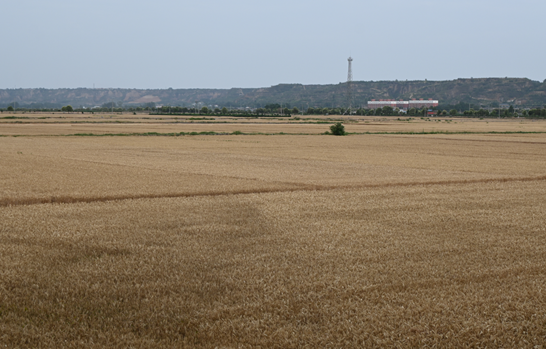
Theoretical assessment records 336,000 wheat ears per mu across demonstration zones, compared to just 257,000 ears per mu in control plots, a differential of 79,000 ears. Calculated theoretical output reaches 562.17 kilogrammes per mu for treated land, against 460.05 kilogrammes per mu on conventionally fertilised ground, marking a 22.2 per cent yield improvement. Following physical harvesting, moisture adjustment and debris clearance, verified real-world production stands at 404.47 kilogrammes per mu in trial plots and 332.04 kilogrammes per mu in control sections, representing a verified harvested yield increase of 21.8 per cent.
The farmland in this trial area falls into the moderately saline-alkali classification. Long-term reliance on conventional chemical fertilisers creates persistent soil compaction, stunting seedling growth with yellowed foliage and underdeveloped root systems. Dry weather triggers upward migration of surface salt deposits, imposing permanent caps on annual grain outputs. Seasonal application of the salt-tolerant bio-organic formulation transforms crop performance metrics, generating sturdier stalks, broader leaf coverage and far more extensive root networks, while significantly suppressing outbreaks of basal stem rot. An extra input cost of 90 yuan per mu delivers an additional 100 kilogrammes of marketable wheat per harvest cycle, with clear, measurable economic returns for growers.
Long-term soil restoration capacity forms a further core advantage recognised by local farming households. The fertiliser blend incorporates salt-resistant functional microorganisms that bind soluble soil salts, break up compacted soil layers and steadily raise organic matter concentrations within topsoil. No supplementary soil remediation materials are required for the subsequent maize crop planted after wheat harvest. A single round of fertiliser input delivers soil conditioning benefits across two consecutive growing seasons, addressing the recurring challenges of weak soil fertility and cyclical salt resurgence endemic to saline farmland.
Panel specialists oversaw every stage of on-site sampling, weighing and statistical computation throughout the field assessment process. The product aligns seamlessly with existing regional cultivation workflows without requiring major adjustments to planting schedules or machinery operations. Low entry costs paired with consistent yield uplifts make the bio-organic fertiliser suitable for large-scale rollout across broad stretches of moderately saline-alkali farmland throughout the Cangzhou administrative area.
Regional agricultural extension teams will arrange further replicated field trials across neighbouring villages over the coming cropping cycles, gathering additional multi-season data to refine recommended application volumes and timing for local climate and soil profiles. Training sessions for rural growers will detail integrated application routines combining base organic fertiliser, seed coatings and foliar amino acid supplements to maximise both grain output and long-term soil health.