Party-led "Village Hub-Zone-Industrial Chain" Framework Fuels Shared Prosperity Across Shangyu’s Rural Areas in Zhejiang
According to Zhejiang local agricultural and rural media outlets, a provincial event for promoting rural entrepreneurship and talent matching was recently hosted in Shangyu District, Shaoxing City. At the venue, village representatives extended warm invitations to young innovators, encouraging them to launch businesses amid mountain villages.
Taiping Mountain Village, once a remote rural outpost, has now become a highly sought-after destination for aspiring rural entrepreneurs. This dramatic shift stems from the integrated development model guided by grassroots party organisations, known locally as the Village Hub-Zone-Industrial Chain mechanism.
Shangyu boasts abundant agricultural produce and year-round fresh fruits, earning its reputation as a major fruit and vegetable supplier for the Yangtze River Delta region. For many years, the district’s rural economy was held back by fragmented resources, narrow single-industry layouts and uneven development across villages.
Separate village operation created fragmented development with limited collective progress under the old model. The three-tier coordinated framework is designed to unify scattered rural resources under the overall coordination of party organisations, carving out a distinct local pathway towards collective affluence unique to Shangyu.
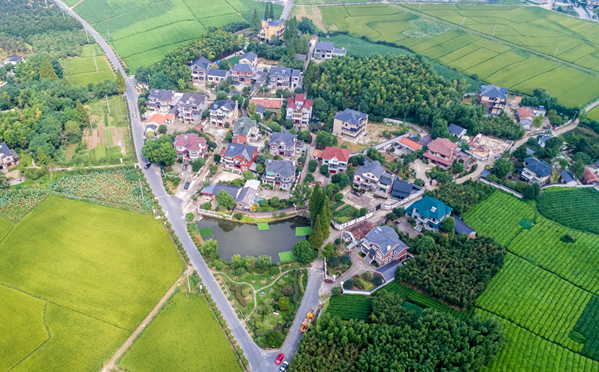
A clear three-level operating structure underpins the whole system with tiered responsibilities and coordinated progress. District-level authorities oversee industrial chains, mapping out shared prosperity industrial routes based on local resource endowments and establishing joint party building coordination mechanisms to drive integrated growth across upstream and downstream agricultural sectors. Town-level authorities manage development zones, grouping multiple villages to build integrated shared prosperity zones that combine crop cultivation, food processing, rural tourism and live-stream e-commerce operations. Individual villages operate grassroots production hubs, rolling out targeted hub construction schemes tailored to local conditions to create local employment and stable income growth for villagers.
The three tiers operate as an interconnected organic system, where grassroots hubs form the foundation, inter-village zones act as supporting branches and district industrial chains serve as the core trunk. Solid village production hubs lay the groundwork for functional rural zones; coordinated zone planning creates a viable platform for industrial chain deployment; thriving industrial operations deliver sustained momentum for both village hubs and integrated rural zones. No single component can deliver full results without the support of the other two.
Lingnan Township’s Fuzi Mountain area stands as a practical demonstration of the model’s effectiveness. The site draws crowds for rapeseed blooms in spring and cherry picking in summer yet sees sparse visitor numbers for the rest of the year. As the designated zone coordinator, the township party committee consolidated land and resource assets from six local villages under a township-owned tourism enterprise, which carries out unified planning, investment attraction and operational management. A diverse range of commercial formats has been rolled out, including artisanal bakeries, cultural merchandise stores, study tour bases and mountain homestays. All core village assets converge around the scenic zone, with revenue distributed back to villages via a guaranteed base turnover plus progressive bonus sharing mechanism.
Isolated scenic marketing by individual villages has been replaced by joint packaged rural experience offerings. The township assembled a cultural tourism team with an average age of 28 to design and launch multiple popular visitor sites. The district’s first all-season fruit retail outlet has recently opened within the zone. Over two years, more than twenty young entrepreneurs have settled locally, tourist footfall has risen by nearly 55 per cent, and average collective operating revenue across the six villages has jumped by seventy per cent.
Inter-village zones resolve structural organisational challenges, while coordinated industrial chains unlock greater value from agricultural raw materials. Chinese medicinal herbs form one of seven core shared prosperity industrial chains prioritised across Shangyu. Within Chenxi Township, the Taiping Mountain-Ganxili shared prosperity zone has been developed, with Huangjing shared prosperity production hubs built around Taiping Mountain Village and surrounding settlements.
The integrated chain layout generates cascading economic benefits. Drawing funding from district-level shared prosperity funds, Chenxi Township built a shared primary processing plant at the zone’s core, equipped with facilities for cleaning, slicing, drying and packaging Huangjing roots. Traditional nine-time steaming and sun-drying processing techniques significantly raise the market value of the herb. Under district-level industrial chain coordination, Taiping Mountain Village partners with relevant local bodies to develop 21 derivative products including Huangjing-infused wine and Huangjing herbal chicken hotpot mixes. Local producers have shifted from selling bulk raw materials by weight to premium finished retail goods priced by gram. The district now hosts 4,000 mu of medicinal herb plantations, forming a concentrated industrial cluster.
Zhangzhen Town demonstrates how the framework turns agricultural waste into marketable goods. Home to East China’s largest red heart kiwi growing and distribution base, the town has built the Youth Kiwi Township shared prosperity zone to extend the full industrial chain. All downstream processing links are established within village-level production hubs.
At Yongchang Wood Industry Shared Prosperity Hub, elderly local residents process discarded kiwi tree branches into cat wands in under two minutes per unit. The e-commerce operator running the hub turns previously discarded branches into a best-selling pet accessory online, shifting over 200,000 units each month.
Industrial chain expansion drives the construction of village production hubs, which in turn deliver direct income growth for rural households. Zhangzhen Town channels kiwi branch recycling, creative design and manual processing into grassroots shared prosperity hubs, ensuring industrial profits flow straight to local families. Payments for cat wand manufacturing alone totalled more than two million yuan to local workers last year.
Elderly villagers secure stable local earnings without relocating to distant urban jobs, balancing income generation with family care. This outcome embodies the district’s operating logic where industrial chains support village hubs, and grassroots production hubs pass economic gains back to local residents. A total of 209 shared prosperity hubs have opened across Shangyu District, creating over 12,000 local jobs and lifting monthly individual earnings by more than 3,000 yuan on average.
The Village Hub-Zone-Industrial Chain system also underpins a unified marketing network for local agricultural goods. Authorities have invested heavily in Shangyu Premium, a regional collective brand for local farm produce over the past two years. Three interconnected sales channels operate in tandem: shared prosperity market fairs, dedicated retail stores and live-stream broadcast studios. Products carrying the brand have recorded combined sales exceeding 250 million yuan through these channels. Operators of grassroots production hubs report far wider market reach for local farm goods under the unified regional brand.
Expanded industrial thinking has unlocked growth momentum for all seven designated shared prosperity industrial chains. As the core settlement of the Liangzhu Ancient Charm rural zone, Zhujiazhuang Village reached a land transfer cooperation agreement with a subsidiary of the district supply and marketing cooperative under the coordination of Fenghui Town party committee. Over 1,800 mu of village land has been consolidated into standardised farmland, and a joint village development enterprise set up Yingtai Farm Shared Prosperity Hub. The project boosts collective village revenue by more than one million yuan and creates local work opportunities for vulnerable rural residents.
Three-year development plans are now finalised for Shangyu District’s rural economy. Authorities will continue advancing the seven core shared prosperity industrial chains covering seasonal fruits, tea, rice and other staple agricultural sectors, with plans to build 14 key integrated rural zones and 40 model shared prosperity production hubs. Household disposable income rises steadily, livelihood stability improves and living standards advance continuously as the party-guided shared prosperity rural development route expands its scale and reach across the whole district.