Smart and Green Transformation Boosts Bulk Cargo Handling Efficiency at Jingjiang Port along the Yangtze
Per Xinhua News dispatches, Deep International Jingjiang Port in Jiangsu Province has rolled out full-scale intelligent remote operation systems and complete low-carbon infrastructure, lifting handling capacity and establishing itself as a benchmark smart and eco-friendly bulk commodity hub on the lower reaches of the Yangtze River.
The cargo vessel Ningfeng 2 carrying 18,500 tonnes of coal has recently berthed at Jingjiang Port to commence transshipment work. One kilometre away from the physical berths lies a central intelligent remote control centre, where operators input parameters including loading modes, working directions and material height via integrated digital interfaces. After one-click confirmation, shore-mounted ship loaders carry out fully automated, precise cargo handling across the dock zone.
This remote operation workflow has become standard daily practice at the terminal. Developed by port operator Deep International, a state-owned enterprise under Shenzhen municipal authorities, Jingjiang Port was fully commissioned at the end of 2024 and has maintained robust throughput growth. Total cargo volume handled in 2025 surpassed 24 million tonnes, while throughput recorded a 26 per cent year-on-year expansion in the first five months of 2026.
Digital upgrading underpins consistent operational acceleration across all dockside procedures. On-site manual cabin operation was mandatory for all transshipment tasks in traditional bulk terminals, requiring multiple staff members to rely solely on visual observation and practical experience to coordinate loading movements. The integrated intelligent control framework now incorporates high-precision positioning, real-time digital modelling, hatch detection and vessel balance monitoring modules, eliminating operational risks such as uneven cargo distribution and delivering smoother, more accurate, fully controllable loading cycles.
The remote command centre functions as the port’s core digital nerve centre, interconnecting data streams from production scheduling, equipment maintenance, safety supervision and real-time video surveillance platforms. A unified visual decision dashboard covers six core operational dimensions: production workflows, mechanical assets, terminal facilities, safety protocols, environmental monitoring and energy consumption. Supported by internet-of-things hardware and digital twin technology, the visual platform delivers live 3D renderings of berths, unloaders and loaders, allowing maintenance teams to track overall terminal operational status at all times.
The port’s digital engineering team confirms that intelligent control systems for the fourth and fifth ship loaders have passed official acceptance and entered formal service, marking another milestone in the terminal’s transition towards low-labour and unmanned operational models. Three stacker-reclaimers and five ship loaders are now equipped with full remote intelligent controls, supporting automatic stockpiling, coal blending and vessel loading without on-site manual intervention. A self-developed comprehensive production management system integrates commercial document processing, vessel dispatching, tally recording and yard allocation functions, breaking down information silos separating port authorities, maritime regulators, shipping firms and cargo clients. The interconnected digital framework delivers unified business collaboration, synchronised regulatory oversight and seamless customer service throughout the entire supply chain.
Synergy between remote control hardware, visual twin dashboards and integrated production software delivers measurable efficiency gains. Overall terminal operational efficiency has risen by approximately 30 per cent year on year. Loading and unloading cycles for 50,000-deadweight-tonne ocean-going vessels take more than ten hours less than the industry average, securing leading handling speeds among all dry bulk terminals along the Yangtze waterway.
Parallel to digital efficiency upgrades, Jingjiang Port maintains strict low-carbon development standards to build a model eco-friendly bulk cargo terminal. Facilities handling coal, ore and other bulk materials generate negligible airborne dust and minimal operational noise, resolving persistent pollution issues typical of conventional dry bulk docks. Clean working zones and orderly maintenance routines sustain sound living conditions for nearby residential communities, supported by sustained green infrastructure investment from Deep International.
The port has pioneered large-span fully enclosed steel storage warehouses, linked by sealed conveyor corridors, dry fog dust suppression equipment, real-time particulate monitoring networks and dedicated wastewater treatment installations. This complete closed-loop intelligent cargo transit system eliminates dust emissions at source for all coal and mineral shipments.
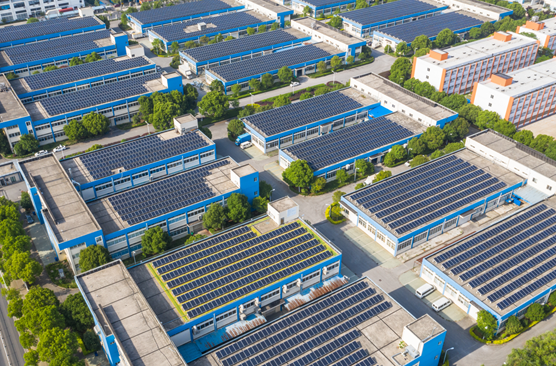
Renewable energy infrastructure extends across the entire storage compound. Rooftop photovoltaic arrays cover nearly 80,000 square metres of the warehouse complex, forming the largest on-port solar power station within Jiangsu Province, equivalent to the surface area of eleven standard football pitches. Annual power generation from the facility reaches 13 million kilowatt-hours. Universal intelligent shore power infrastructure is deployed across all berths, enabling zero-emission energy supply for all moored vessels and establishing a complete energy-saving low-carbon operational framework.
Digital transformation remains the core development priority for all subsequent port upgrades, with technological innovation acting as the primary driver to foster advanced productive forces and reinforce long-term operational competitiveness. Technical teams continue to optimise remote automation algorithms and expand renewable energy generation capacity, while scheduling divisions adjust vessel berthing timetables to align with peak solar power output windows. Port management also expands digital data sharing channels with inland logistics partners to streamline cross-regional bulk commodity distribution networks across the Yangtze River Economic Belt.