Digital Tech Powers Summer Farming Campaigns as CETC Delivers End-to-End Smart Agricultural Solutions
Across China’s countryside, the annual triple-summer farming cycle unfolds from southern regions northwards, bringing widespread grain harvests supported by cutting-edge digital and information technologies. China Electronics Technology Group Corporation leverages its strengths in information engineering to upgrade full-cycle crop management systems, reinforcing stable domestic grain supply capacity across the country.
Intelligent Machinery Systems Streamline Summer Wheat Field Operations
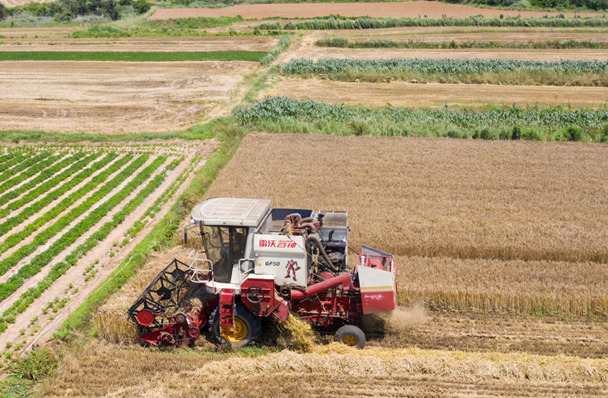
Golden wheat fields in Hebei Province host fleets of intelligent farm machinery carrying out large-scale harvesting work. Built around BeiDou navigation and big data analytical frameworks, integrated machinery supervision platforms connect agricultural equipment manufacturers and village farming cooperatives, delivering unified digital solutions covering ploughing, sowing, crop maintenance and grain collection.
Self-developed BeiDou intelligent monitoring terminals manufactured by the group fit all mainstream farm machinery models, capturing real-time operational data to support automatic acreage calculation, movement trajectory playback and centimetre-level positioning. Dedicated control modules for silage harvesters feature dual operating modes and built-in safety lock mechanisms, adjusting cutter clearance automatically to raise harvesting throughput and preserve crop quality. Precision corn seeding control units standardise field workflows and lift overall operational efficiency throughout post-growth harvesting phases.
Smart Sensor Networks Monitor Field Moisture and Mitigate Farming Risks
Unstable weather patterns, uneven soil moisture distribution and inconsistent crop development create recurring hurdles for seasonal agricultural output. A suite of custom intelligent sensing devices operates as continuous monitoring nodes across farmland, forming interconnected early warning networks for disaster prevention and loss reduction.
Throughout wheat harvesting periods, canopy temperature sensors, crop growth detectors and six-element meteorological monitors collect continuous field data to predict threats including dry hot wind damage and crop lodging. The data enables growers to coordinate machinery deployment, capitalise on dry weather windows for full grain recovery and arrange systematic grain drying schedules. Once harvesting concludes and summer planting commences, regional soil moisture probes and layered soil temperature-humidity observers deliver round-the-clock precise readings of subsurface conditions. Agricultural technicians draw on these datasets to guide timely sowing and targeted irrigation activities. Auxiliary systems tracking vegetation photosynthesis and seedling development track plant progress in real time, flag pest infestations and abnormal growth patterns at an early stage to limit yield losses before issues escalate.
Millimetre-wave Radar and Specialised Cameras Optimise Intelligent Grain Depot Management
Millimetre-wave volumetric imaging radar technology engineered by China Electronics Technology Group generates nearly one million cloud data points to perform all-round three-dimensional scans of grain storage facilities. The hardware delivers accurate measurements of stored grain height and total volume while rendering live 3D visual models of grain stockpiles, simplifying inventory audits and supporting coordinated upstream and downstream production scheduling for grain management departments.
Mechanical ventilation and circulating fumigation pest control form two core daily procedures within automated grain depots. Purpose-built anti-fumigation surveillance cameras deliver uninterrupted live monitoring during ventilation and pest treatment cycles, preventing unauthorised human entry into high-risk operational zones. Microbial activity within stored grain naturally generates phosphine and copper-corrosive gases; the monitoring hardware is fully adapted to such harsh indoor environments. Equipped with white light supplementary illumination, the equipment reproduces true colour imagery clearly, removing visual barriers that previously obscured grain discolouration and moth infestation activity, creating robust safeguards for stored grain quality and warehouse operational safety.
Domestic agricultural digitalisation schemes keep expanding nationwide, with Ministry of Industry and Information Technology rolling out support policies to accelerate the uptake of BeiDou-enabled smart farm equipment, environmental sensor networks and automated grain storage infrastructure. Agricultural equipment manufacturers, technology research institutions and rural cooperative organisations maintain ongoing collaborative development to refine intelligent farming hardware tailored to diverse regional crop varieties and climatic conditions. Research and development work will continue to advance lightweight sensing terminals, high-precision positioning modules and warehouse monitoring radar systems, widening the application scope of digital technology across every segment of seasonal grain production and long-term grain reserve management.