Jiangsu in full summer harvest swing with robust guarantees for grain output and storage
Summer wheat harvesting is underway across Jiangsu Province as more than 36 million mu of wheat crops reach full maturity, with harvesting operations rolling out gradually from the southern to northern parts of the region. Local authorities and agricultural departments have deployed multi-pronged measures to support orderly summer agricultural production, securing high yields and full grain collection for the 2025 summer harvest season.
Modern mechanised harvesting is driving efficient grain production across major grain-growing areas in Jiangsu. At the high-standard farmland in Lanhuatang, Pukou District of Nanjing, crawler harvesters operate continuously to complete cutting, threshing and cleaning in one streamlined process. Ripe wheat grains are directly delivered to transport vehicles, while crop straw is processed and discharged on-site to support efficient and eco-friendly farm operations. Local grain-growing bases have reported solid crop performance, with plump wheat ears and heavy grains forming a strong foundation for high yields. The average wheat yield in core planting zones has reached 608.5 kilograms per mu, representing a year-on-year increase of around 30 kilograms.
Huai’an, a key grain-producing city in Jiangsu, hosts 4.78 million mu of wheat fields with well-developed and mature crops. Local agricultural authorities have launched comprehensive preparations for the summer harvest, covering mechanical equipment deployment, emergency reserve arrangement, fuel supply guarantee and post-harvest drying services. Professional technicians have carried out targeted maintenance and inspection for farming machinery across agricultural cooperatives and family farms.
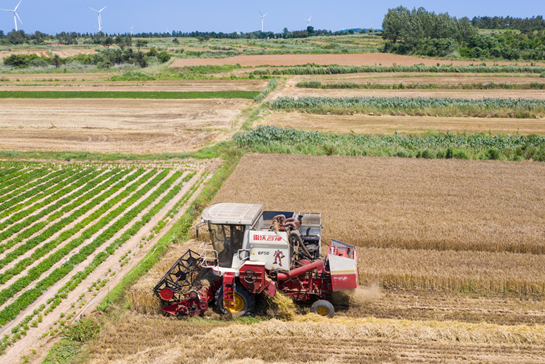
All 12,000 combine harvesters in Huai’an have completed full pre-harvest inspections to ensure stable operational performance during the peak harvesting period. The city’s daily maximum harvesting capacity can reach 950,000 mu during peak seasons, with a stable daily harvesting volume of around 500,000 mu. In addition, 748 professional grain drying centres across the city have finished equipment debugging and staff training, delivering a batch drying capacity of 78,000 tonnes to effectively tackle post-harvest grain drying demands.
According to official data from Jiangsu Provincial Bureau of Grain and Material Reserves, the province is expected to produce 24.65 billion jin of summer commercial grain crops in 2025. Farmers are projected to sell 19.9 billion jin of grain during the peak sales period, while grain enterprises are set to purchase 18.01 billion jin in total. The province has prepared adequate storage resources with 22.44 billion jin of available grain warehouse capacity, including 22.37 billion jin for wheat and 70 million jin for rapeseed, ensuring sufficient storage space for summer grain collection.
Jiangsu has completed comprehensive pre-arrangements for summer grain purchasing work. In mid-April, the provincial grain authority held special meetings to analyse the summer grain purchase situation and wheat market trends. According to People’s Network Jiangsu branch, the province has coordinated the Jiangsu branch of the Agricultural Development Bank of China to allocate an initial 20 billion yuan of special credit funds to guarantee sufficient capital support for grain purchasing.
The province will prioritise the purchasing of high-quality grain sources and expand the scale of order-based grain acquisition to standardise market transactions and protect farmers’ interests. A series of upgrading plans for grain storage and logistics systems are being advanced, including the construction of approximately 300,000 tonnes of new grain warehouse capacity. Ongoing upgrades aim to lift the province’s intact grain warehouse capacity to over 45 million tonnes by the end of 2030.
Jiangsu will further optimise the structure of grain material reserves, implement a three-year action plan for digital grain reserve development, and build a professional grain brand system. The province will advance the construction of the “Suliang Zhilian” technological docking platform and accelerate the development of 28 grain and logistics industrial parks, forming a more intelligent, efficient and secure modern grain reserve and circulation system to underpin stable grain supply security.