Science and Talent Drive Revival of Jinhua Two-Ended Black Pig Industry in Zhejiang
In Jinhua City, Zhejiang Province, the Key Laboratory of Genetic Breeding and Improvement of Jinhua Two-Ended Black Pig, located in the College of Agriculture of Jinhua Polytechnic, has made remarkable achievements in recent years. Covering the exploration and utilization of high-quality germplasm resources, the construction of standardized large-scale breeding systems, and meat quality analysis and product development, the laboratory is quietly transforming the development trajectory of a local characteristic industry.
China Agriculture News reports that the Jinhua Two-Ended Black Pig, also known as Jinhua Pig, gets its name from its black head and tail and white middle body. With a breeding history of more than 1,700 years, it is hailed as the “Chinese Panda Pig” and is one of China’s first local pig breeds under the protection of livestock and poultry genetic resources. However, for a long time, this “national treasure-level” pig breed was once on the verge of extinction due to slow growth rate, high breeding costs and low lean meat rate.
Since its establishment in 2023, the laboratory has focused on the protection and exploration of germplasm resources. By the end of last year, it had collected and preserved high-quality germplasm resources of Jinhua Two-Ended Black Pig Line I, II and III. To address the problems of high feed conversion ratio and low lean meat rate, the laboratory has used whole-genome sequencing technology to accelerate the breeding of new strains with high lean meat rate.
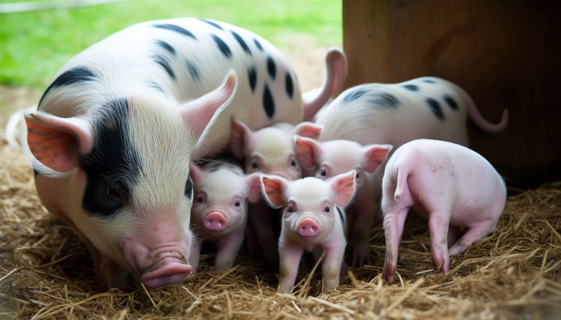
“We are not simply improving the breed, but targeting the cultivation of special strains for ham on the basis of retaining high-quality genes,” said Li Junrong, head of the laboratory team. He added that by optimizing key traits such as leg plumpness and fat uniformity, the laboratory has solved the disconnection between raw materials and processing from the source. In addition, the laboratory found that the content of various high-quality flavor substances in the Jinhua Two-Ended Black Pig is significantly higher than that in other pig breeds.
“This scientifically explains why the ham made from Jinhua Two-Ended Black Pig has a particularly unique flavor,” Li Junrong noted. To transform these research achievements into a “wealth code” for farmers and enterprises, the team has guided farmers in scientific breeding through “science and technology commissioners”, “hundreds of doctors entering enterprises” and “doctoral innovation workstations”.
Local enterprises regularly send pork to the laboratory for testing and adjust their breeding plans according to the results. While strengthening scientific and technological research, Jinhua Polytechnic has jointly established the Jinhua Ham College with Jinhua Municipal Administration for Market Regulation, Jinhua Ham Industry Association and leading enterprises in the industry to address the aging staff and talent shortage in Jinhua ham production enterprises.
The college has set up a ham class, and 36 students have stood out through strict selection to become potential successors of the ham industry. “We focus on both scientific and technological empowerment to break the bottleneck of raw material quality through the Two-Ended Black Pig Laboratory, and talent training to cultivate inheritors through the Ham College,” said a relevant person in charge of Jinhua Polytechnic.
Data shows that in 2025, the feeding volume of local pigs in Jinhua reached 221,000, with 9,033 breeding sows in stock and 122,000 commercial pigs slaughtered, increasing by 9.5% and 35% year-on-year respectively. The total output value of the whole industrial chain reached 1.65 billion yuan. Jinhua Municipal Government has put forward a five-year goal: by 2030, the production capacity of Two-Ended Black Pig will exceed 1 million, and the output of Two-Ended Black Pig ham will reach more than 200,000.