Late-Ripening Cherries in Yunnan’s Shenjiagou Village Thrive, Boosting Rural Prosperity
While cherries in most regions have long been out of season, the late-ripening cherries in Shenjiagou Village, Qinggangling Township, Zhaoyang District, Zhaotong City, Yunnan Province, are in full bloom and welcoming visitors from near and far. In recent years, the village’s cherries have enjoyed booming sales and growing fame, a success attributed to the joint efforts of local Party committees, governments and fruit farmers, with external support and internal quality improvement working hand in hand.
Zhaotong News Network reported that cherries are delicate with a short preservation period, making storage and transportation difficult and limiting their market reach. To address these challenges, the Party committee and government of Qinggangling Township have taken practical measures to help fruit farmers, organizing cherry picking activities in Shenjiagou Village to attract visitors and boost sales, thus promoting villagers’ income and industrial development.
During the cherry blossom season, media reporters are invited to take photos and videos for extensive publicity, showcasing the pure white and fragrant blossoms that promise a bumper harvest. When the cherries ripen, the hillsides are covered with clusters of bright red, plump fruits, like flames burning among the green leaves. The picking activities feature supporting programs such as cultural performances, village history museum exhibitions and Sayu Smoke Willow scenery, offering visitors a feast for both taste and sight. The adjacent cherry trading market is bustling with buyers and sellers, adding to the lively atmosphere.
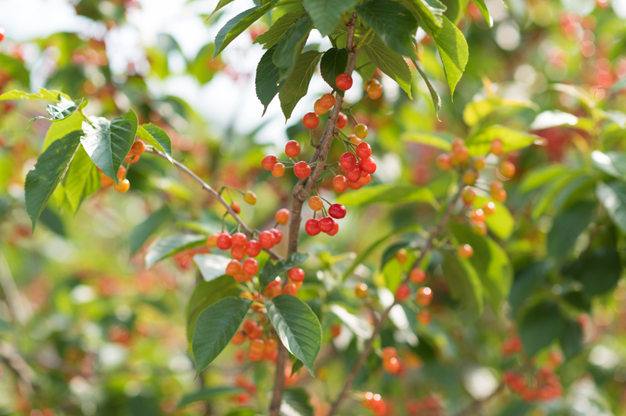
Chen Rangkai, former Party secretary of Shenjiagou Village, said, "Due to climatic and geographical factors, our cherries ripen later. These late-ripening cherries are our village’s calling card and the main industry for villagers to increase their income. The cherry picking activities organized by the township government attract tens of thousands of visitors every year, allowing fruit farmers to sell all their cherries without leaving the village." He added that during the 2024 picking season, the daily peak traffic exceeded 4,000 vehicles, with over 10,000 visitors and consumption surpassing 1 million yuan. The village has nearly 2,000 mu of cherry trees, involving more than 1,000 households, with an annual output value of nearly 10 million yuan and an average annual income of over 3 million yuan.
Chen Guangqi, a large-scale cherry grower, recalled the hardships of selling cherries in the past: "Years ago, we had to get up before dawn and travel 10 to 20 kilometers to sell cherries in Sayu Town or Zhaotong City. The bumpy ride damaged the cherries, forcing us to accept lower prices." Now, with the annual picking activities, the cherries have gained great popularity. "I have 11 mu of land with over 600 cherry trees, producing more than 2,500 kilograms of cherries every year. I don’t worry about sales at all and can sell them all while sitting by the orchard, earning over 100,000 yuan annually," he said.
The high quality of the cherries is the foundation of their success. Chen Kebao, deputy Party secretary of Shenjiagou Village, noted that inheriting old varieties and introducing new ones is key to sustainable development. Villagers cherish and carefully cultivate old varieties, which are juicy, large and sweet. Seventy-three-year-old Chen Guangfu, with over 40 years of cherry planting experience, grows 4 mu of old-variety cherries, yielding 700 kilograms annually and earning about 30,000 yuan. "My cherries are pre-ordered early, sold at 40 yuan per kilogram with guaranteed quality," he said proudly.
New varieties such as "Red Lantern", "Red Agate" and "Horse Milk" are also well-received for their bright color, large size, thin skin and sweet taste. With scientific management, these varieties have strong disaster resistance and broad market prospects. People’s Network reported that Zhaoyang District now has over 10,000 mu of cherry trees, with Shenjiagou Village as a key planting area, and the late-ripening cherries have become a model for rural revitalization through characteristic agriculture.