Chongqing’s Bayu Beautiful and Harmonious Villages Blossom with Prosperity and Civilization
In mid-spring, tender green shoots of Coptis chinensis emerge in Huangshui Town, Shizhu County, located in the Wuling Mountains of Chongqing. “Last year, I harvested Coptis from four mu of land, about 700 jin per mu. With good market conditions in recent two years, I earned around 450,000 yuan,” said Wang Jixiang, a Coptis grower, with a smile. “Growing Coptis at home is no worse than working outside.”
In the Wuling Mountains, this bitter medicinal herb has become a key way for local farmers to increase their income. According to Chongqing Daily, Shizhu County produced 4,100 tons of Coptis in 2025, accounting for about 60% of China’s total output, with a processing output value of 1.15 billion yuan. As a city integrating large cities, rural areas, mountainous regions and reservoirs, Chongqing has promoted the construction of Bayu Beautiful and Harmonious Villages by learning from the “Ten-Thousand-Village Project” experience and adapting measures to local conditions.
Prosperous industries are the foundation of beautiful villages. Huaxi Village in Zhongyi Township, Shizhu County, once faced the dilemma of “lacking leading industries and zero collective economic income” due to its steep mountains and fragmented land. In recent years, local cadres and villagers have developed characteristic agriculture such as polygonatum, Coptis, papaya and Chinese bees. “Cadres must be experts themselves to lead villagers to develop industries well,” said Wang Xiangsheng, Secretary of the Party Branch of Huaxi Village.
The village has 11 municipal and county-level experts in residence, who have trained 29 local “expert farmers”. By selecting fine polygonatum seeds, building seedling bases and promoting the under-forest intercropping model of “polygonatum + papaya”, the planting area has expanded from 220 mu to 400 mu, with an expected total output value of 16 million yuan. It has also extended the industrial chain, launching more than 10 products such as polygonatum noodles and tea, some of which are sold overseas.
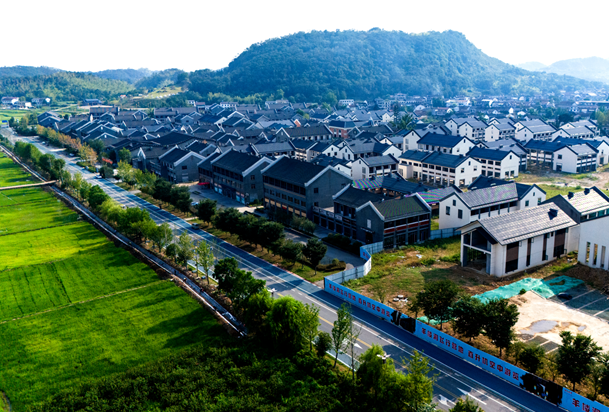
While industries thrive, rural living environments have also been upgraded. “In the past, there was messy around houses; now courtyards are clean and decorated with flowers and trees,” said Wen Feng, a resident of Jiangjiawan, Nanquan Street, Banan District. According to Xu Guangze, Secretary of the Party Working Committee of Nanquan Street, the district has carried out micro-renovation of villages through the “Bashi Courtyard” initiative, creating 36 such courtyards that drive the planting of 2,400 mu of loquats and 350 mu of citrus and peaches, with annual sales of 1.6 million yuan in 2025.
Rural civilization has also been enhanced. In Ganquan Village, Manyue Town, Kaizhou District, villager Xie De’an exchanged a bucket of oil and a bag of flour with points at the “Power Love Point Exchange Supermarket”. “Previously, villagers thought village affairs were ‘public matters’ and only watched. Now we can earn points for cleaning and pruning trees to exchange for goods, which boosts participation,” he said. The supermarket, co-operated by State Grid Chongqing Kaizhou Power Supply Company and the village committee, stimulates villagers’ enthusiasm for rural governance.
Wang Shijie, Deputy Director of Chongqing Municipal Agriculture and Rural Commission, said: “In 2025, the per capita disposable income of rural residents in Chongqing reached 23,448 yuan, an increase of 5.5%, the urban-rural income ratio narrowed to 2.21:1, and the completion rate of Bayu Beautiful and Harmonious Villages reached 65%.” Today, across Chongqing, beautiful villages with prosperous industries, beautiful environments and civilized customs are blooming brightly.