Hubei Tea Industry Shines: From Thousand-Billion Output to Global Brand Influence
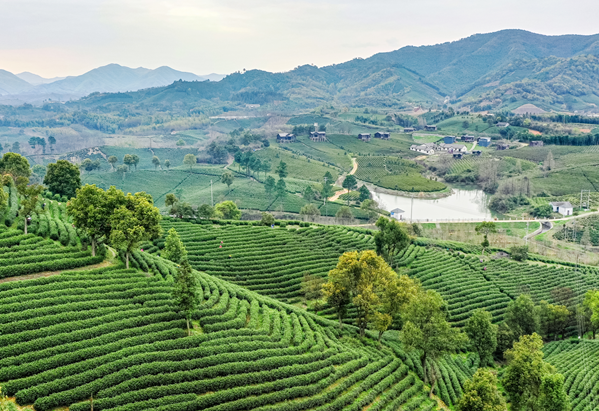
In April, Hubei’s tea mountains are covered with greenery, as the province’s 5.84 million mu of tea gardens enter the peak harvest season one after another. Busy scenes of tea picking and processing can be seen everywhere in the five major tea-producing areas: Wuling Mountain, Dabie Mountain, Qinba Mountain, Mufu Mountain and Dahong Mountain, according to Hubei Daily.
Once a major tea-producing province plagued by numerous but obscure brands, Hubei has taken decisive steps to boost its tea industry’s high-quality development. In 2024, the province designated “Chutian Hao” as its public brand for the tea industry and issued the “Ten Measures for Promoting High-Quality Development of the Tea Industry”, covering the entire industrial chain from variety improvement to brand optimization. It was learned from the 2026 Hubei Tea Industry Chain Construction Promotion Conference held recently that the comprehensive output value of Hubei’s tea industry has exceeded 100 billion yuan.
“Our high-end tea series are selling extremely well this year, with many customers booking half a year in advance,” said Tan Shuling, deputy general manager of Runbang Tea Industry, while checking orders at the brand operation center in Wuhan. Behind this boom is the enhanced market trust brought by unified brand identification, standards and supervision, marking a profound shift of Hubei tea from price competition to quality, culture and service competition.
Zhang Wenqi, chairman of Runbang Tea Industry, said the “Ten Measures” strengthened their determination to improve quality and promote Enshi Yulu. The company built China’s first Enshi Yulu Museum in 2023 and named a satellite “Runbang Yulu” in March this year, using satellite remote sensing to achieve precise tea garden management. At the 2026 Hubei Chutian High-Quality Tea Promotion Conference, its Enshi Yulu, featuring green dry tea, light green soup and green leaves, left a deep impression on guests.
Yicha Group, formed in 2022 to integrate five old tea enterprises, has turned scattered resources into a cohesive force. “On the first day of the online spring tea carnival, we sold over 20,000 cans of Caihua Maojian, with sales exceeding 2 million yuan in 6 hours,” introduced Wang Wu, chairman of Caihua Tea Industry, adding that Caihua Maojian won the “Tea King” title in the green tea category last year.
Hubei has focused on quality improvement, building 2 million mu of high-standard ecological tea gardens and keeping the tea quality pass rate above 99% for years, according to the Hubei Tea Industry Chain Working Group. It has bred 20 national-level fine tea varieties and built 59 new matcha production lines, with production capacity increasing more than 7 times since 2023.
The province is also pushing its tea brands to go global. In 2025, 14 key tea enterprises participated in international exhibitions in Hong Kong, Germany and France, securing intended cooperation worth over 37 million US dollars, said China News Service. Yuhuangjian Tea Industry is adjusting its varieties to meet European certification standards, while Banbingwei Tea Industry has developed products adapted to Nordic consumption habits.
In 2025, Hubei’s tea export volume reached 30,800 tons, up 9.2% year-on-year, with a comprehensive output value of 101 billion yuan. With “Chutian Hao” as the core, Hubei’s tea industry is striding forward on a path of high-quality development from scale expansion to quality and efficiency improvement.