Guangzhou Builds a Vibrant Blue Economy Picture Through Modern Marine Ranch Industrial Chain
As dawn breaks over Guangzhou, the Huangsha Seafood Center comes alive with vitality. Merchants unlock intelligent seafood tanks, where Boston lobsters wave their claws and Nansha green crabs crawl in natural seawater supplied 24 hours a day. In the afternoon, artificially bred corals stretch their tentacles in urban aquarium shops, bringing the beauty of the deep sea to city life. At night, live-stream hosts hold freshly sorted fish maw to explain its nourishing effects, with orders pouring in from across the country. Since the 14th Five-Year Plan period, Guangzhou, Guangdong Province, has been constructing a new blue economy landscape that combines the warmth of daily life with technological innovation, focusing on the full industrial chain development of modern marine ranches.
According to China Youth Net, the rise of marine fisheries in Guangzhou stems from its accurate grasp of resource endowments. As a city born by water, Guangzhou boasts inherent advantages in seed industry, science and technology, equipment manufacturing and circulation. In July 2024, the Implementation Plan for the Construction of the Full Industrial Chain of Modern Marine Ranches in Guangzhou was officially issued, with the clear strategic goal of building "one highland and two centers" — a highland for R&D of key generic technologies in the full industrial chain, a manufacturing center for modern marine ranch equipment, and an international aquatic products trading center in Guangzhou, providing strong support for the construction of marine ranches in the province.
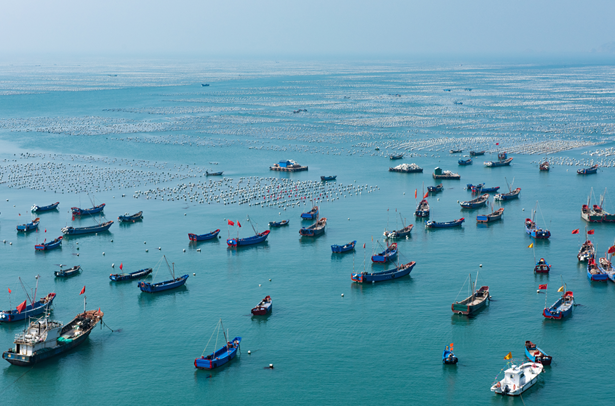
Technological empowerment has revitalized the "core chip" of the marine seed industry, the core competitiveness of the R&D highland. At the Guangzhou (Nansha) Chinese Bahaba Protection and Research Center, the team led by Academician Chen Songlin has overcome the artificial breeding technology of Chinese bahaba, successfully hatching 3,500 fry and giving hope for the continuation of this "giant panda in the water". Meanwhile, the marine ornamental organism germplasm resource bank established by the South China Sea Fisheries Research Institute in conjunction with enterprises has successfully bred more than 50 rare marine species such as corals and tridacna, preserving over 1,000 marine ornamental organism germplasms and forming a complete chain of "protection-R&D-supply".
Equipment intelligence has built a "blue granary" for deep-sea aquaculture, demonstrating the strong strength of the manufacturing center. In the Nansha Longxue Island Shipbuilding Base, leading enterprises such as Guangzhou Shipyard International and Huangpu Wenchong, together with scientific research institutions, have built large-scale marine aquaculture equipment by virtue of their advantages in marine engineering equipment manufacturing.
Four large truss-type aquaculture platforms including "Pusheng No.1" and "Xinhuan No.1" have been successfully delivered, the semi-submersible comprehensive aquaculture equipment "Mintou Huian No.1" has been put into use, and the world's first salmon aquaculture vessel "Suhai No.1" has undergone sea trials in the South China Sea. More notably, high-tech enterprises such as Youyu Technology and Haibao Optoelectronics have emerged, and small intelligent equipment such as precision feeding systems, intelligent disease early warning and underwater robots have become the "standard configuration" for aquaculture projects in the province, enabling Guangzhou to move from "equipment output" to "standard output" and "model output".
According to CNR News, the upgraded circulation system has gathered fresh flavors from around the world, establishing the hub position of the trading center. In September 2025, the Huangsha Seafood Center, invested 1.7 billion yuan and covering a total construction area of 110,000 square meters, officially opened.
This modern "aquatic aircraft carrier", with the country's first integrated supply system of "natural seawater-oxygen-refrigerant", keeps seafood in the best fresh state.
The "Digital Huangsha" platform realizes full-link digitalization of transactions, logistics and traceability, and the design of separate pedestrian and vehicle flows as well as dry and wet areas has refreshed the purchasing experience.
The supporting intelligent aquatic product safety center conducts daily rapid inspection and public announcement, and the "advance compensation" mechanism ensures consumer confidence. It is not only the "national aquatic product price vane", but also a new cultural, commercial and tourism landmark integrating transactions, logistics, exhibitions, e-commerce and cultural tourism.
The 124,000-ton storage capacity of Huadu Yuhu Cold Chain Trading Center further connects Guangzhou's cold chain logistics network to the world, escorting the circulation of marine food.
From "a single fish" to "an entire industrial chain", Guangzhou's marine fisheries are more than just fresh flavors. With the continuous expansion of brand influence and the in-depth integration of industries, Guangzhou is steadily weaving a beautiful blue economy picture that integrates technology, ecology and economy.