Industrial Vitality Boosts Rural Revitalization in Lingbi, Northern Anhui
Spring has arrived early in northern Anhui, bringing vitality to the land. A visit to the assistance factories in Zhuqiao Village and Lingguang Village of Yuji Town, Lingbi County, Suzhou City, reveals neatly arranged CNC machine tools, constantly updating data on screens, and workers operating skillfully. Automated equipment runs at high speed, with precision drills rolling off the production line one after another and tungsten steel grinding rotary files taking shape quickly. The roar of machines composes a forging movement for the comprehensive rural revitalization.
These assistance factories are quietly changing the life trajectory of local residents. Since settling in the assistance factories in 2018, the hardware processing enterprises in Zhuqiao Village have gradually covered several surrounding villages, providing nearly 100 employment positions and giving priority to recruiting nearby villagers and people lifted out of poverty. Meanwhile, the automated monitoring system accurately controls the production process, enabling one worker to take charge of multiple machines, which has improved both efficiency and product quality.
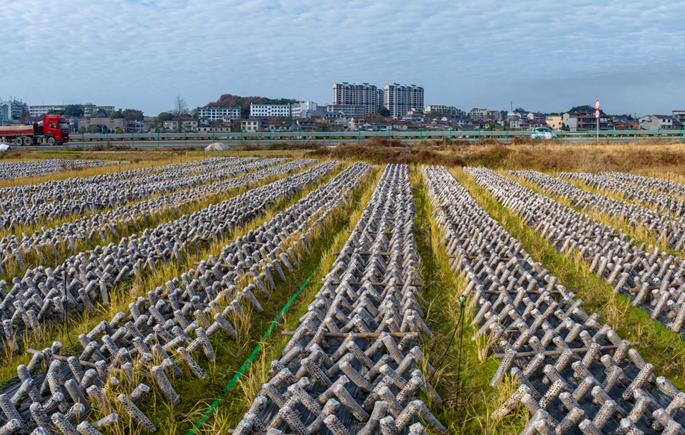
Industrial revitalization in Lingbi is not limited to hardware processing; the edible fungi industry in Yangtuan Town is also thriving with vitality. In 2025, the town’s planting scale exceeded 1.2 million square meters, with an annual output of more than 36,000 tons of button mushrooms and 20 million bags of velvet shank mushrooms. It has driven more than 2,000 employment opportunities and has now become the largest edible fungi distribution center in northern Anhui and the third largest button mushroom production base in the country.
From assistance workshops to edible fungi bases, these scenes are vivid reflections of Lingbi’s efforts to build a diversified industrial and employment system. In recent years, based on its resource endowments, Lingbi has developed modern agriculture, taking “brand grain and oil” as the foundation, “edible fungi” and “beef cattle” as the pillars, and developing characteristic planting in coordination. It has formed a development pattern where large factories complement small workshops and traditional industries advance alongside characteristic industries, exploring a new path for preventing return to poverty, promoting income increase and achieving common prosperity.
The shift from “working away from home” to “employment at the doorstep” and from “people lifted out of poverty” to “industrial workers” shows that Lingbi’s various characteristic industries and assistance workshops have supported the people’s dream of getting rich and injected new vitality into rural revitalization. A picture of common prosperity featuring “enterprises increasing efficiency, people increasing income and collectives gaining benefits” is gradually unfolding across the land of Lingbi.