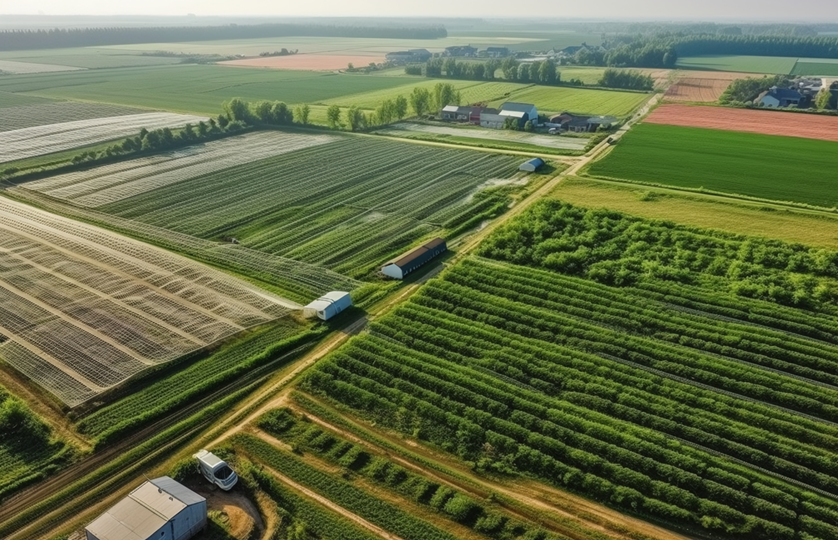
Technology Empowers Spring Wheat Management in Feicheng, Shandong
As spring returns to the earth and all things take on new vitality, agricultural work is in full swing. Currently, 602,000 mu of winter wheat in Feicheng City, Tai’an, Shandong Province, has fully entered the greening and growth period, marking a crucial juncture for spring field management. In recent days, Feicheng has fully implemented the requirements of Shandong Province’s "Agricultural Technology for Strong Seedlings" campaign, making overall arrangements and promoting linkage between upper and lower levels. It has focused on all spring management work through mechanization to improve efficiency, technology to enhance quality, and agricultural guidance to provide protection, laying a solid foundation for the stable and high yield of summer grain.
In the contiguous wheat fields of Shagou Village, Xincheng Sub-district, greenery is gradually thickening. A large-scale grain grower is operating a drone shuttling over the fields, accurately spraying foliar fertilizer on weak seedlings. "At present, each wheat plant has only two tillers, weaker than previous years. The key focus of spring management is to ‘promote’—promoting weak seedlings to become strong and accelerating root development," he said. He added that drones apply fertilizer efficiently and evenly, and when combined with sprinkler and flood irrigation, they can help wheat seedlings grow better and turn green faster. This scene is a vivid reflection of Feicheng seizing the agricultural season and empowering spring field management with technology.
Such a busy scene is also common in the hinterland of Wenyangtian in Anjiazhuang Town, a core grain production area in Feicheng, where 94,500 mu of winter wheat is growing well. In the "One Piece of Field" demonstration area of Caijiayanzi Village, a picture of spring farming empowered by technology and diligent farmers is slowly unfolding.
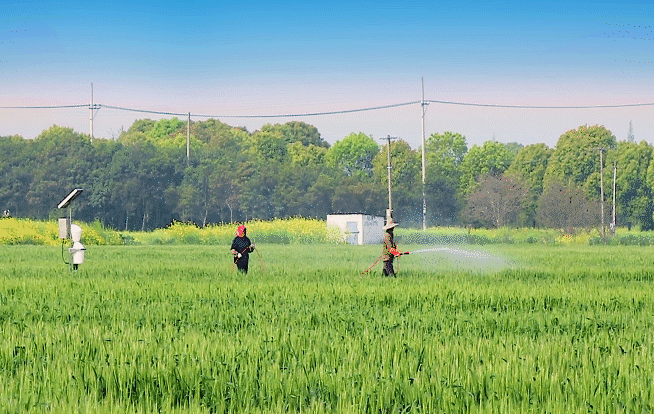
On the field ridge, a post-90s large-scale grain grower holds a remote control, skillfully operating a drone hovering back and forth over the wheat fields. Fertilizer mist, mixed with the fragrance of soil, moistens every wheat seedling. "In the past, topdressing relied entirely on manual sprayers. More than 60 mu of land would take three to four days to finish, leaving me exhausted and worried about uneven spraying," he said with a smile, enumerating the benefits of technology-enabled farming. "Now with drones, I can finish topdressing over 100 mu a day, and the fertilizer application can be precisely controlled according to soil fertility, increasing fertilizer utilization rate by more than 20%—it’s convenient and efficient."
Not far away, in the unmanned farm of Wali Village, another picture of smart spring ploughing is quietly unfolding. A translational automatic sprinkler system operates slowly, with fine water mist covering the wheat fields like a light yarn. The person in charge of the village takes out his mobile phone, opens a smart agriculture app, and real-time data such as soil moisture, field temperature and irrigation progress are updated and clearly visible.
"Sensors are buried in the soil, and the crops’ needs are reflected through data. The system accurately calculates whether to water and how much water to use," he sighed. Thanks to the in-depth empowerment of the "One Piece of Field" reform and smart agriculture, the old days of "relying on the weather and experience to farm" are a thing of the past. Now, precise irrigation can be achieved with a few taps on the phone, making farming more convenient and efficient.
Affected by the autumn floods last year, the sowing of winter wheat in Feicheng was generally delayed, and the overall seedling growth was relatively weak, posing a challenge to this year’s spring management. To address this, the local agricultural and rural department has joined hands with towns and sub-districts, integrating agricultural technical forces to form service teams. Agricultural technicians have gone deep into the fields, acting as "spring management nannies" for farmers, providing "point-to-point" precise guidance and delivering scientific farming technologies to the fields and farmers’ hearts.
In the wheat fields of Shangqian Village, Anjiazhuang Town, an agricultural technician squats on the ridge, parts a cluster of wheat seedlings, and explains to the surrounding farmers on site: "This seedling has only two tillers, which is weak. We must seize the good soil moisture after rain to topdress, but the dosage should not exceed 15 jin. Don’t water it yet; a drop in soil temperature will hinder growth." Generally, wheat seedlings are classified into three grades, with grade III (weak seedlings) having 1-2 tillers per plant, grade II having 2-3 tillers, and grade I having 3-5 tillers—more tillers mean more guaranteed yield.
Such "field classes" are held in villages and towns across Feicheng. Practical technologies, from rolling timing and topdressing dosage to soil moisture regulation and pest monitoring, are delivered to farmers. "A visit from agricultural technicians is much better than us figuring it out ourselves; it gives us peace of mind," a villager said with a smile.
With proper spring management, a bumper harvest is in sight. At present, the 602,000 mu of wheat in the city is growing well, with grade I and II seedlings accounting for 61.8%, an increase of 4.1 percentage points from before the Spring Festival. From drone topdressing to intelligent irrigation, from agricultural technology going to the countryside to data-driven farming, a high-tech "spring management picture" is spreading across the fields of hope, nurturing infinite possibilities for a summer grain harvest.