Colourful Folk Events Unfold Across China to Mark the Dragon Boat Festival
As cited by Xinhua News Agency and People’s Daily Online, a rich array of cultural activities spanning river races, handicraft workshops and folk rituals are unfolding in towns and cities nationwide to celebrate the Dragon Boat Festival, also known as Duanwu Festival, a millennia-old traditional Chinese observance falling on the fifth day of the fifth lunar month.
Water-based dragon boat racing forms the centrepiece of celebrations across riverine and coastal regions. Along the Pearl River Delta waterways in Guangdong, more than 170 dragon boats converge at Liede Village’s watercourse for time-honoured village exchange races, with teams from neighbouring towns paddling in formation amid cheering crowds lining the banks. The Greater Bay Area Dragon Boat Invitational Tournament held in Zhongshan gathers crews from 11 Greater Bay Area cities and university sports teams, introducing youth-only divisions to draw young competitors onto the water. Unique regional variants of boat racing can be found nationwide: six-century-old night-time dragon boat races take place in Changle, Fuzhou, while standing-paddle boat displays run in Huangmei, Hubei, a tradition derived from ancient military drills. Coastal venues such as Haikou Bay stage offshore dragon boat contests amid natural tides, welcoming participants from Southeast Asian nations alongside domestic squads. Landlocked areas have crafted alternative customs; Li Town in Jiangjin, Chongqing, hosts land-based dragon boat parades accompanied by folk mountain ballads, a 400-year-old practice created for communities without large water bodies.
Hands-on craft and food-making sessions fill community spaces, cultural venues and heritage museums across the country. In Zigui, Hubei, widely recognised as the hometown of Qu Yuan, large-scale public workshops invite visitors to fold reed leaves into ox-horn shaped zongzi, the glutinous rice dumplings synonymous with the festival, guided by local master artisans. Community events in Jinan, Shandong, organise group dumpling-making sessions, with finished parcels distributed to elderly residents, street cleaners and delivery workers to share festive warmth. Cross-cultural experience zones in Neijiang, Sichuan, and Qingdao, Shandong, host joint dumpling-making activities for local residents and overseas visitors, creating opportunities for cultural exchange.
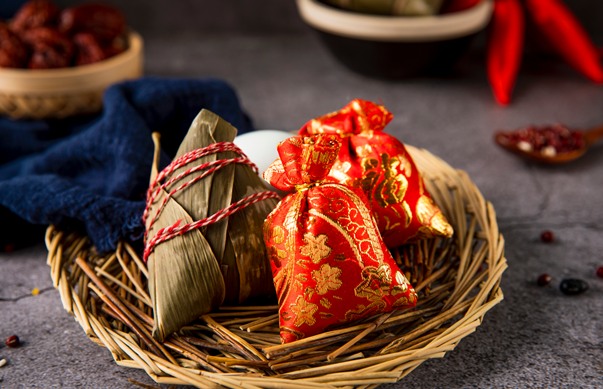
Heritage handicraft workshops focus on traditional aromatic sachets, woven five-colour silk bracelets and mugwort floral arrangements. Qingyang in Gansu, home to time-honoured embroidered sachet craft, opens street stalls displaying creative pouches shaped like tigers, zongzi and contemporary national trend motifs, with youth-focused mugwort bouquets combining calamus, bergamot and bamboo packaging gaining strong market traction this year. Tourists in Zigui and Tongren, Guizhou, can follow intangible cultural heritage practitioners to stitch embroidered herbal sachets and carve ornate wooden dragon boat heads, learning craft techniques passed down through generations. A full range of seasonal rituals including hanging bundles of mugwort and calamus above doorframes, symbolic of dispelling negative energy and welcoming wellbeing, are widely practised by households across northern and southern provinces alike.
The festival programme integrates immersive cultural performances and themed exhibitions to interpret historical roots. Folk opera, dragon and lion dances, traditional Chinese medicine displays and calligraphy demonstrations run alongside major race events in municipal parks and cultural squares. Sites dedicated to Qu Yuan’s legacy stage recitals of ancient verses and ritual ceremonies honouring the revered ancient poet, allowing attendees to engage with the patriotic and cultural connotations of the festival. Cultural tourism operators roll out packaged itineraries featuring combined experiences of boat racing, handicraft creation and rural food tastings, lifting footfall for heritage villages and scenic zones.
Domestic travel platforms record sustained growth in searches for Duanwu-themed travel and experiential products, with destinations offering intangible heritage workshops ranking high on domestic traveller preference lists. Cultural and tourism authorities keep rolling out supporting initiatives to expand the reach of traditional folk customs, pairing classic rituals with modern creative products tailored for younger generations. Supply chains for festival handicrafts, seasonal food ingredients and floral ritual goods expand production capacity to meet rising domestic consumer demand.
Cultural exchange activities linked to the Dragon Boat Festival also take shape outside China’s borders. Dragon boat tournaments in Cape Town, South Africa, and cities across the United Kingdom attract mixed teams of local residents and overseas Chinese, acting as accessible channels to share Chinese folk traditions with global audiences. Domestic cultural institutions continue cross-border folk culture cooperation, exchanging festival activity planning experience with overseas cultural organisations to facilitate wider international understanding of Chinese traditional festivals.
Local authorities will maintain the organisation of inclusive public cultural events in subsequent holiday periods, developing new hybrid activities that balance preserved ancient customs with contemporary creative design. Manufacturers of traditional festival goods will continue refining product lines to suit diverse consumer groups, while tourism operators expand multi-scene cultural experience offerings across urban and rural locations.