Xinye Village: An Ancient Settlement Blending Heritage Protection with Vitality in Zhejiang
Stepping into Xinye Village, Daciyan Town, Jiande City, Zhejiang Province, one feels as if entering a simple and serene agricultural painting. Nearby, shallow paddy fields stretch out, with lotus fragrance curling in summer; in the distance, green mountains stand as a screen, surrounded by trees all year round. Hidden among the lush forests, a graceful white pagoda stands tall—it is the Tuanyun Pagoda, the landmark of this ancient village. Xinhua News Agency reported that this village, with a history of over 800 years, perfectly integrates traditional culture with modern vitality.
"This pagoda was built to promote literary fortune, just like a brush pointing straight to the sky, encouraging scholars to achieve great success," said Ye Xianjie, Secretary of the Party Committee of Xinye Village, standing close to the pagoda. More than 300 years after the completion of Tuanyun Pagoda, a Wenchang Pavilion, symbolizing respect for culture and education, was built locally. The village is also dotted with many academies, private schools, free schools and official schools, with its cultural context continuing to this day. "The ideal and pursuit of ‘farming and reading to pass down the family’ have always been the background of Xinye," Ye added.
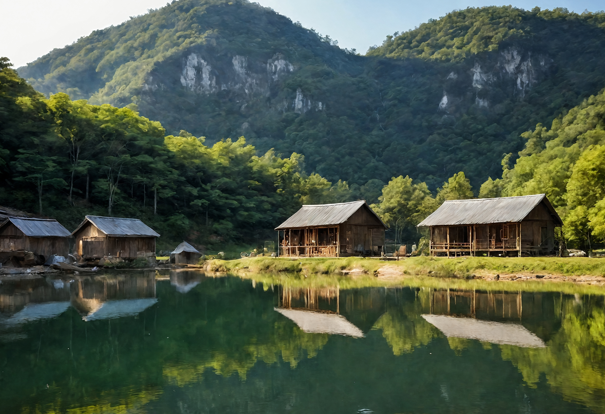
Founded during the Jiading period of the Southern Song Dynasty, Xinye Village features an overall layout of "mountains rising in the northwest and water gathering in the southeast". It was included in the first batch of China’s Traditional Village List in 2012, and its "local architecture" was listed as a national key cultural relic protection unit in 2013. After more than 800 years of precipitation, the village still preserves 16 ancient ancestral halls, halls, pagodas and temples, as well as over 200 ancient dwellings, earning it the reputation of "an open-air museum of Ming and Qing architecture".
Chen Zhichang, a staff member of Jiande Cultural Heritage Protection Center, said that to understand Xinye, one must first understand its ancient architecture. Take the ancestral halls as an example—they are numerous, hierarchical and complete in specifications, carrying rich historical and folk information. The Youxu Hall, built in the Yuan Dynasty, was once the main ancestral hall of the Ye clan in Yuhua, with an exquisite stage still preserved in the gatehouse. "One can imagine the scene of festivals in the past, when the stage was bustling with gongs and drums, and clansmen gathered to enjoy family happiness," Chen noted.
A closer look reveals that components such as brackets, beams, dougong, wooden walls and window lattices are all decorated with exquisite wood carvings, depicting figures, beasts, flowers, birds and opera scenes with smooth lines and vivid expressions. Xinhua News Agency pointed out that Jiande is a national demonstration county for the concentrated and contiguous protection and utilization of traditional villages, and Xinye Village is an important part of this demonstration.
In recent years, with policy support, hundreds of certified rural construction craftsmen have been active in the front line of Xinye’s protection. "For the ancient buildings in Xinye, renovation should be as close to the original as possible to restore their historical style," a relevant person in charge of Jiande Municipal Bureau of Housing and Urban-Rural Development said. Xinye Village was included in the list of typical cases of protection and utilization of traditional villages in Zhejiang Province in June 2025.
Chen Zhichang, known as the "living map of the ancient village" by villagers for his over 40 years of grass-roots cultural relic protection research, said he has long hoped to attract more young people to Xinye. In the past five years, the village’s tourism income has exceeded 20 million yuan, with its "March 3rd" traditional temple fair becoming a cultural card. Jiang Yuhan, Member of the Party Committee of Daciyan Town, said, "We will not only keep the root of the traditional village, but also build a stage for modern cultural activities to protect, inherit and utilize the traditional village through improving the industrial chain."