Wild Crested Ibis Breeding Confirmed in Dawu, Hubei, Boosting Population Recovery
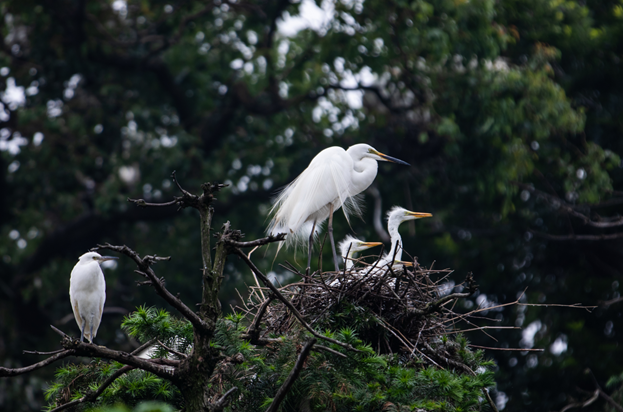
Wildlife monitoring researchers have recently confirmed a pair of crested ibis parents nesting and hatching eggs in Wanling Village, Dongxin Township of Dawu County, Hubei Province. This discovery has increased the number of wild breeding crested ibis pairs in Dawu to five, laying a solid foundation for the continuous growth of the local crested ibis population.
Crested ibises, a first-class national protected bird in China known as the "giant panda of birds", were once on the brink of extinction globally, with only seven wild individuals found in Shaanxi Province in 1981. China’s efforts in crested ibis conservation have since become a successful model for saving endangered species worldwide, with the global population now exceeding 10,000.
"Observation shows that the newly discovered nest in Dawu has eggs and the parents are brooding, while the old nest from last year is also in the hatching stage, all going well," said Cai Dejing, deputy director of the Crested Ibis Breeding Station at Dongzhai National Nature Reserve in Luoshan County, Henan Province, adjacent to Dawu. January to June is the crested ibis breeding season, the busiest period for field monitoring.
With a large activity range and elusive traces, wild crested ibises require persistent observation. Cai, who has long engaged in monitoring and protection research of wild crested ibises in the Dabie Mountains, has been guiding local efforts since the first two wild crested ibises migrated from Dongzhai to Dawu in 2021.
"This is a critical period for wild crested ibis breeding. No high-disturbance production or human activities should be carried out in or around the nesting areas, to avoid scaring the birds and causing nest abandonment or breeding failure," warned Huang Hua, a crested ibis protection expert.
The discovery of wild breeding is a vivid practice of ecological civilization and a testament to Dawu’s long-term adherence to ecological priority and scientific protection. Since 2021, a joint management team has been established, including staff from Dawu County’s Ecology and Environment Bureau, Forestry Bureau, local towns, volunteers and villagers, to comprehensively protect the birds by monitoring foraging routes, eliminating potential hazards and popularizing protection knowledge.
To date, Dawu has formed a stable wild crested ibis population of more than 50 individuals, with their distribution expanding from Dongxin Township to multiple towns, covering over 100 square kilometers across Hubei and Henan provinces.
Dawu’s superior ecological environment provides ideal conditions for crested ibises to thrive. Last year, the county built 110 "Ten-Thousand-Tree Villages" and afforested 128,600 mu of land, winning titles including the National "Two Mountains" Practice Innovation Base and Provincial Ecological Civilization Construction Demonstration County. It has become a veritable "natural habitat" for rare species, known as a "bird paradise" with 74 wild bird species and 42 national or provincial key protected wildlife species settling there.