Flower-Viewing Economy Booms Across China, Boosting Rural Revitalization and Consumption Upgrade
According to China Tourism News, flower-viewing tours have accounted for more than 50% of China’s spring tourism market this year. From the water towns in the south of the Yangtze River to the plateaus in the west, the spring economy centered on flowers is thriving nationwide. This consumption boom, which originated from natural landscapes, has evolved from simple “photo-taking and hasty visits” into a comprehensive economic phenomenon integrating cultural experience, leisure vacations and industrial upgrading, shifting from “short-term traffic” to “long-term value” and injecting sustained momentum into rural revitalization and consumption upgrading.
The sustainability of the flower-viewing economy depends not only on the beauty of flowers but also on the practical value provided to tourists beyond the scenery. For a long time, the flower-viewing economy in many places remained in an extensive stage of “one season of flowers, one-day tours”, simply equating it with ticket sales. Tourists left in a hurry after taking photos, and the bustle faded away as the flowering season ended. Today’s tourists, however, are no longer satisfied with just taking photos; they crave a sense of relaxation close to nature, a sense of participation and memorable experiences, requiring local authorities to move beyond the narrow focus on “only viewing flowers” to a pattern of “diversified integration”.
The core of this “integration” is to break down barriers and organically connect various elements such as agriculture, culture, tourism and commerce, allowing a single flower to support a complete consumption chain covering accommodation, catering, transportation, travel, shopping and entertainment. For instance, Xinjin in Chengdu and Bishan in Chongqing have integrated local characteristic catering and traditional cultural interactive experiences into flower fields, enabling tourists to taste authentic flavors and experience local customs after viewing flowers.
Wuyuan in Jiangxi combines rape flowers with ancient village sightseeing, agricultural experiences, homestay vacations and photography tours, enriching the flower-viewing journey. “Integrating multiple elements makes tourists stay longer and spend more actively,” said Zhang Lijun, manager of Wuyuan Tourism Development Co., Ltd. “It’s the key to transforming short-term traffic into long-term development momentum.”
Cultural empowerment is essential to making the “integration” work. Without cultural connotation, flowers are just fleeting scenery. Longyan in Fujian integrates Hakka folk songs and folk markets with flower seas, turning them into carriers for inheriting Hakka culture. Longwu Tea Town in Hangzhou creates a new Chinese-style living scene among tea mountains and flower seas, allowing tourists to feel the elegance and profoundness of tea culture while viewing flowers.
According to People’s Network, different regions have distinct resource endowments, so the flower-viewing economy cannot follow a one-size-fits-all model. The key is to integrate ecology with industry and take ecological restoration as the starting point of industrial development. Guangfeng District in Shangrao has transformed abandoned mining areas into a 1,000-mu Chinese hydrangea base, which once was a barren sand-mining wasteland but now blooms like snow, improving the ecological environment and increasing the income of more than 300 surrounding households.
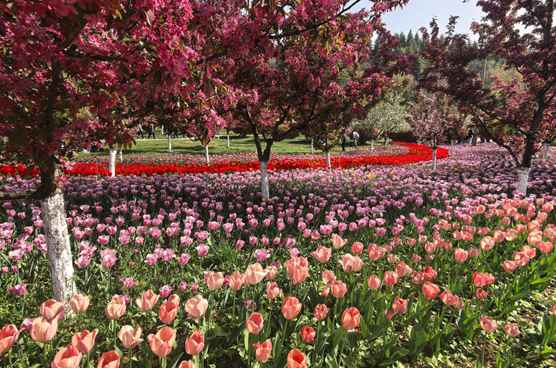
Yancheng in Jiangsu has turned saline-alkali wastelands into Dafeng Dutch Flower Sea, known as “China’s No.1 Tulip Flower Sea”, which drives an annual local output value of over 300 million yuan. According to China Government Network, these practices are in line with the national policy of promoting in-depth integration of rural culture and tourism and developing characteristic rural industries.
In the initial stage of the “14th Five-Year Plan”, the transformation of the flower-viewing economy is a vivid reflection of the “mutual progress” between consumption upgrading and rural revitalization. It turns the seasonal popularity of flower seas into a long-term driving force for regional development and people’s well-being. With continuous exploration in integration and cultural empowerment, the flower-viewing economy is blooming into a hope for people’s prosperity across China.