Beijing’s New Regulation Offers Solutions for Great Wall Protection and Utilization
BEIJING, April 9, 2026 – How to safeguard the Great Wall across regions? What to do about tourists climbing "wild Great Wall"? How to open eligible sections in an orderly manner? These public concerns about Great Wall protection have been addressed with the recent implementation of the Beijing Great Wall Protection Regulation (hereinafter referred to as the "Regulation"), according to People’s Daily.
As Beijing’s first local regulation specifically targeting Great Wall protection, it not only elevates the legislative level of Great Wall protection from a government rule to a local regulation but also achieves major breakthroughs in protection scope, cross-regional collaborative protection and activated utilization.
Compared with the 2003 Measures for the Protection and Administration of the Great Wall in Beijing, the Regulation establishes the "comprehensive protection" concept at the legislative level for the first time, expanding the protection scope to the Great Wall itself, related cultural heritage and its living environment. This means that not only the Great Wall’s walls, castles, passes, beacon towers, watchtowers and horse-blocking walls are protected, but also ancient roads, fortress villages and intangible cultural heritage closely related to the Great Wall’s defense system, as well as surrounding mountains, rivers, landforms and vegetation that form the Great Wall’s living environment, are all included in the legal protection scope.
The Regulation strengthens scientific and technological support, promoting the establishment of an intelligent supervision system featuring "space-ground integration, dynamic monitoring and data sharing". Remote sensing mapping, 3D modeling and other technological means are adopted to realize real-time perception and early warning of risks to the Great Wall itself and its environment. A digital archive platform is built simultaneously to systematically record the Great Wall’s structural characteristics and protection status, providing data support for restoration design and risk management. "High technology will enhance the scientificity of Great Wall protection, transforming it from ‘visible’ to ‘manageable’ and ensuring its precision and sustainability," said Tang Yuyang, professor at Beijing University of Civil Engineering and Architecture and executive vice president of Beijing Great Wall Culture Research Institute.
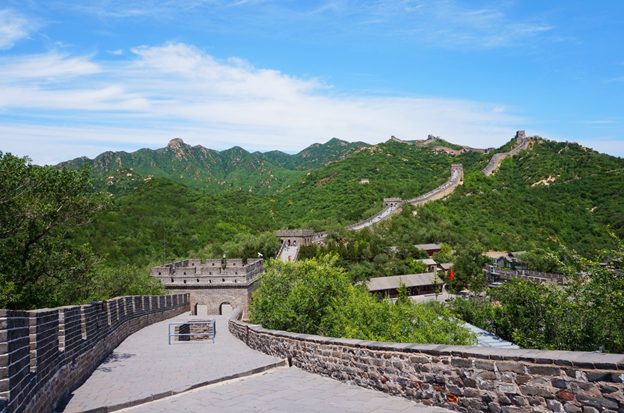
Stretching 520.77 kilometers across six districts from east to west – Pinggu, Miyun, Huairou, Changping, Yanqing and Mentougou – the Beijing section of the Great Wall is a large linear cultural heritage. To protect it well, the Regulation defines the principle of "overall protection, segmented management and hierarchical responsibility", specifying that protection funds be included in the fiscal budget. It improves the multi-department collaborative governance pattern, strengthens the territorial responsibility of towns and townships, and enhances daily inspection and monitoring.
To address the problem of tourists climbing "wild Great Wall", the Regulation innovates supervision methods, allowing district cultural relics departments and Great Wall protection institutions to use technological means such as electronic fences to prompt climbing risks and discourage such behaviors, making protection management more refined. "We used to patrol the Great Wall manually; with technological support, we can better guard it," said Liu Hongyan, a Great Wall protector.
With a special chapter on "Utilization and Inheritance", the Regulation establishes an evaluation, management and dynamic adjustment system for visiting areas, adhering to the principle of "protection first, rational utilization" to promote the construction of the Great Wall National Cultural Park and the Great Wall Cultural Belt. Eligible sections will be opened in an orderly manner by verifying tourist carrying capacity and promoting appointment and traffic restriction measures, gradually meeting the public’s demand to approach and get close to the Great Wall.
Currently, Yanqing District is integrating local Great Wall resources to build a large Badaling Great Wall Scenic Area, with a 16.5-kilometer Great Wall tour line to be opened soon, connecting Shuiguan Great Wall, Badaling Great Wall, Ancient Great Wall and Huajiayao Great Wall. "This year, we will promote the connection and opening of the Badaling to Huajiayao section," said Li Jing, deputy director of Yanqing District Great Wall Management Office, adding that Yanqing is planning three themed tourist routes to lay the foundation for the large scenic area.
Relevant person in charge of Beijing Municipal Bureau of Cultural Relics stated that supporting documents such as the Measures for the Administration of Great Wall Visiting Areas will be formulated to ensure the effective implementation of the Regulation, providing a "Beijing model" for the protection and utilization of large linear cultural heritage nationwide.