Torch Festival: A Millennium-Old Ritual Ignites Jinsuo Island in Dali Year-Round
On Jinsuo Island in Erhai Lake, Dali, a grand celebration centered on fire lights up the quiet isle into an all-night feast every 25th day of the sixth lunar month — the Bai ethnic group’s Torch Festival. More than a simple folk performance, it is a magnificent ritual blending history, legend, belief and ethnic sentiment, offering visitors a cultural dialogue spanning thousands of years and standing out as the highlight of the eastern coast area in Dali’s one-day tours.
Unlike many traditional festivals that are only celebrated on specific dates, the enthusiasm of the Torch Festival can be felt every day on Jinsuo Island. Tourists do not need to choose a specific time to visit Dali; they can participate in the Bai Torch Festival 365 days a year, immersing themselves in the ethnic culture at any time.
The origin of the Torch Festival dates back to the Nanzhao period (around the Tang Dynasty), rooted in a solemn historical legend. At that time, the Dali area was home to six tribes known as the "Six Zhaos". The Nanzhao King Piroge intended to unify the six tribes and held a feast at Songming Tower, inviting the leaders of the other five tribes. Among them, Madame Baijie, the wife of the leader of Dengtan Zhao, was intelligent and foresaw danger, giving her husband an iron bracelet as a warning before he left.
As anticipated, Piroge set fire to Songming Tower during the feast, and all five tribal leaders perished in the flames. Upon hearing the news, Madame Baijie led her people to the scene with torches overnight, digging through the ashes with her bare hands until her fingers bled, and finally identified her husband’s remains by the iron bracelet. Refusing to yield to Nanzhao’s coercion to remarry, she threw herself into Erhai Lake to uphold her integrity.
To commemorate this loyal, brave and intelligent woman, the Bai people light torches every 25th day of the sixth lunar month, symbolizing the fire that illuminated her search for her husband’s body and her unyielding loyalty and courage like burning flames.
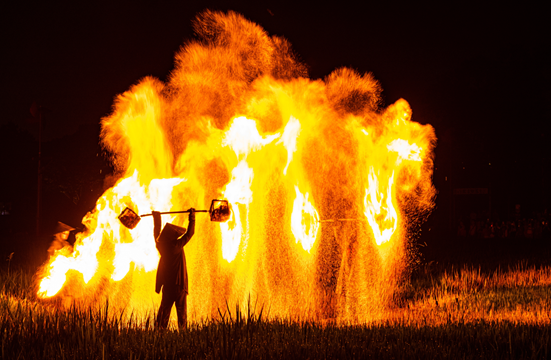
Over time, the Torch Festival has evolved from a solemn historical memory into a carnival for all. On Jinsuo Island, a pine torch over ten meters high is erected in the central square, topped with a "shengdou" (a measuring tool) and colorful flags, symbolizing a bumper harvest. The most exciting part is sprinkling rosin powder: locals hold rosin powder and sprinkle it onto the torch, creating a sudden "boom" as flames pour down like a waterfall, with onlookers cheering enthusiastically. Sprinkling rosin powder on each other is a way to exchange blessings, meaning "burning away bad luck and welcoming good fortune".
Young people bravely jump over small bonfires, while children are held by adults to walk around the fire three times, praying for peace and health. Bai men and women dance around the fire, singing traditional "Daben Qu" (big book ballad-singing), whose lyrics often eulogize Madame Baijie and praise love and life.
The Torch Festival is a must-experience for visitors: it is a photography paradise where countless fire spots interweave with Erhai Lake’s reflection at night, forming a visually striking scene. It also offers in-depth cultural immersion — not a performance, but a sincere emotional expression of the Bai people. Visitors can wear Bai costumes, learn to sprinkle rosin powder, and even be invited to villagers’ homes to share festival feasts.
The official Torch Festival falls on the 25th day of the sixth lunar month (around mid-July in the Gregorian calendar), held on Jinsuo Island and Yanhuodonghai on Jinsuo Island. Visitors are advised to wear cotton clothes to avoid flammable chemical fibers, prepare small gifts such as candies and drinks to show kindness to villagers, and bring anti-shake equipment for photography while paying attention to the direction of the flames. Notably, a Torch Festival bonfire party is held every night at Yanhuodonghai on Jinsuo Island.
On Jinsuo Island, the Torch Festival is more than a celebration; it is a modern expression of Madame Baijie’s spirit, a reminder of history for the Bai people, and a prayer for the future. When visitors hold rosin and sprinkle it onto the flames, they become participants in this millennium-old ritual, not just tourists.