Guizhou’s Cultural and Tourism Market Booms in Opening Year of 14th Five-Year Plan
During this year’s Spring Festival holiday, Guizhou’s cultural and tourism market witnessed a booming start, with tourists exploring the "Huang Xiaoxi Has Dinner" premium route, enjoying a bird’s-eye view from Huajiang Grand Canyon Bridge – known as the "world’s highest bridge" – and participating in rural evening parties to celebrate the Spring Festival. The province received a total of 32.6924 million tourists and achieved a total tourism consumption of 21.735 billion yuan, with year-on-year growth of 14.62% and 15.08% respectively on a comparable basis. This double-digit growth highlights the growing appeal of the "Colorful Guizhou" cultural and tourism brand and the vigorous momentum of Guizhou’s high-quality tourism development, shifting from "boom in one season" to "tourism available all year round" and from single sightseeing to diversified experiences.
As the opening year of the 14th Five-Year Plan, Guizhou adheres to integrating culture with tourism and promoting culture through tourism. Centering on the three core elements of resources, tourists and services, it has thoroughly implemented the "Four Major Actions" for tourism industrialization, systematically positioned the cultural and tourism industry as an important pillar industry, strived to build a new "Colorful Guizhou" cultural and tourism brand, and continuously pushed the tourism industry to a higher level.
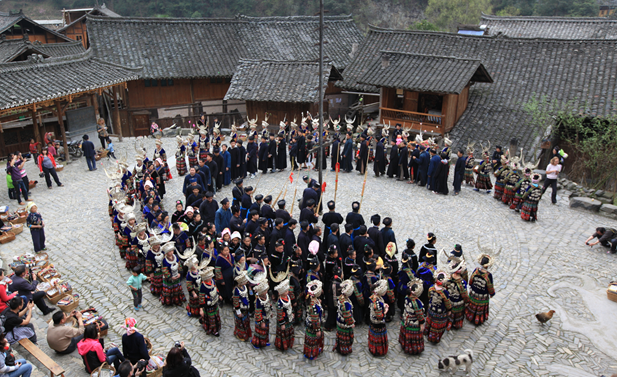
Known as the "Mountain Park Province," Guizhou ranks first in China in the number of world natural heritage sites, boasting beautiful natural scenery and rich ethnic customs. In recent years, focusing on upgrading key scenic spots along the "Huang Xiaoxi Has Dinner" route, the province has continuously promoted the development of well-known scenic spots, including Huangguoshu Waterfall, Libo Xiaoqikong, Xijiang Qianhu Miao Village, Chishui Danxia, Wanfenglin and Fanjing Mountain, connecting scattered scenic spots into a coherent line. It has also promoted the construction of first-class tourist cities in qualified cities and counties such as Guiyang, Anshun and Xingyi, gradually forming an all-region tourism development pattern. In 2025, the number of tourists and total tourism consumption in Guizhou increased by 8.9% and 11.1% year-on-year respectively, while outbound and inbound tourists rose by 15.3% and 50.1% year-on-year, maintaining a trend of "higher popularity and greater vitality" in the cultural and tourism industry. In 2026, Guizhou will continue to promote the construction of key scenic spots and first-class tourist cities, support Xijiang Qianhu Miao Village in applying for the 5A-level scenic spot certification, and accelerate the transformation of resource advantages into industrial and brand advantages.
Diversified integrated formats have become the key to Guizhou’s continuous popularity in cultural and tourism. Adhering to the concept of "tourism + multi-industry" integration, Guizhou has deepened the integration of cultural tourism, sports tourism, bridge tourism and wine tourism, enriching tourism product supply and achieving "no slack in off-season and more prosperity in peak season." The immersive experience at the Guizhou Long March Culture Digital Art Museum, known as the "Red Ribbon," has made revolutionary history tangible and boosted the popularity of red research tourism; Huajiang Grand Canyon Bridge integrates popular science education and sightseeing, becoming a popular self-driving destination; Maotai Town in Zunyi combines wine culture with tourism, forming a unique experience of "tasting Maotai-flavor wine and traveling in Guizhou’s mountains and rivers."
Leveraging its unique climate advantage of "summer cooling and winter warmth," Guizhou has focused on developing "Guizhou residential tourism," accelerating the construction of three residential tourism belts and promoting the transformation from "sightseeing" to "residential vacation." In 2025, the number of tourism-related business entities in the province reached 357,100, including 4,151 large-scale enterprises and 58 tourism enterprises with annual revenue exceeding 100 million yuan. In 2026, Guizhou will expand the residential tourism industry, improve service standards, and promote the scaling, branding and marketization of integrated formats.
Digital empowerment has significantly improved Guizhou’s tourism service level. The digital image spokesperson "Huang Xiaoxi" can provide AI-customized travel plans for tourists, while the "One Code Travel Guizhou" platform covers all links of travel services, ranking among the top echelons of provincial-level smart cultural and tourism platforms in China. By the end of 2025, the province had 286 star-rated hotels and about 13,000 homestay operators, ranking among the top in China. It has opened 210 direct scenic spot bus routes and established a "30-minute complaint response" mechanism. The 240-hour transit visa-free policy has yielded remarkable results, with over 295,000 inbound and outbound passengers at Guiyang Airport in 2025, a year-on-year increase of 150.26%.
Standing at the new starting point of the 14th Five-Year Plan, Guizhou is making steady progress in transforming its ecological and resource advantages into development advantages, striving to brighten the new "Colorful Guizhou" cultural and tourism brand with its natural and cultural treasures.