Yunnan’s Zhiju Village Hosts Centuries-Old Costume Festival, Interpreting the Charm of "Life in Yunnan"
On the day of this year’s Lantern Festival, Zhiju Village in Zhonghe Town, Yongren County, Chuxiong Yi Autonomous Prefecture, Yunnan Province, kicked off an original ecological costume competition festival. Known as "Saizhuang," this intangible cultural heritage (ICH) folk custom with a history of over a thousand years takes costumes as the medium and culture as the soul, gathering local residents and tourists from all directions. Surrounded by green mountains, it vividly interprets the profound connotation of "There is a kind of life called Yunnan" and revitalizes this millennium-old ICH in a lively atmosphere.
Located within the radiation area of the ancient Southern Silk Road’s Tea-Horse Road, Zhiju Village retains traces of the legendary horse caravans everywhere, from its winding mountain roads to the simple local dialect. As the root of Yongren’s costume culture, the village’s costume competition has long transcended the scope of clothing beauty contests, becoming an important carrier for Yi people to inherit their culture and gather for reunion. On the day of the festival, the entire village is immersed in a festive atmosphere: villagers wear exquisitely sewn Yi costumes, adorned with silver ornaments and embroidered clothes, smiling warmly; guests and tourists come from far and wide, holding cameras to record the moments and following the singing into this cultural feast.
The arrival of spring in Yunnan is hidden in the green pine needles of Zhiju Village. From the welcome area at the village entrance to the festival venue, the ground and steps are covered with thick pine needles—a sincere ritual for Yi people to welcome distinguished guests and hold grand ceremonies, embodying their simple enthusiasm. Around the performance square, villagers and tourists sit on the hillside steps, with the cool mountain breeze brushing their faces, as a cultural performance spanning a thousand years is about to begin.
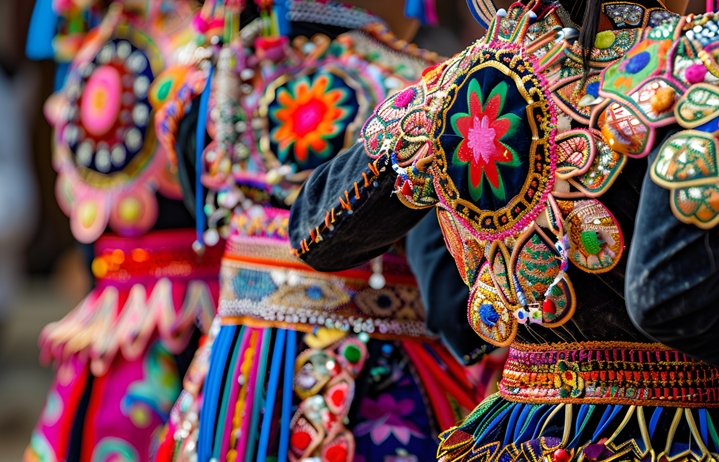
As a Bimo chants prayers, the festival flame is lit, flocks of sheep enter slowly to a primitive rhythm, and the deep sound of ox horn horns echoes in the valley, marking the official start of the costume show. Embroidered clothes are like rainbows, with bright red, yellow and blue threads weaving exquisite patterns; silver ornaments shine like stars, tinkling as people walk and telling stories of the Yi people. From the steady and dignified "Village Elders’ Guzhe" performed by the elderly men’s team, the ancient and gorgeous "Gushi Guna Zhe" by the elderly women’s team, to the bold and unrestrained "Qiao Ta Guzhe" by the men’s team and the vibrant "Ni Ta Guzhe" by the young men and women’s team, each performance vividly interprets the costume culture, showing not only the clothing styles of different age groups but also the optimistic attitude towards life of the Yi people.
Serving as a cultural bridge connecting agricultural sacrifice and costume aesthetics, the costume competition condenses the evolutionary process of the Yi ancestors from hunting to farming, carrying the ethnic group’s profound feelings of reverence for nature, love for life and longing for a bumper harvest. Having been passed down for thousands of years, it still maintains strong vitality.
The younger generation has become the most touching scene of cultural inheritance at the lively festival. From toddlers aged one or two to teenagers in their teens, they wear exquisite Yi costumes and walk confidently on the stage, continuing the millennium-old cultural context with their innocent love. A 13-year-old girl, who has participated in the festival since she was 7, even embroidered her own costume this year. Though she cannot fully understand the cultural significance behind every stitch, her pure love and pride have already rooted the costume culture deeply in the hearts of the younger generation.
The costume competition in Zhiju Village is a vivid microcosm of the inheritance and development of excellent traditional Chinese culture in Yi areas. What the "competition" really showcases is the Yi people’s yearning for a better life, their love for their ethnic culture, and their sincere wishes for good weather, peaceful homes and bumper harvests.
As the sun sets, the grand festival comes to an end, but the cheerful singing, exquisite embroidered clothes and warm smiles remain deeply in everyone’s hearts. The Zhiju costume competition has long transcended the superficial meaning of beauty contests, becoming a spiritual link that engraves the Yi people’s historical memories, carries their folk customs and embodies their life expectations. It also provides the most vivid and profound interpretation of "There is a kind of life called Yunnan," allowing the excellent traditional Yi culture to thrive and bloom in the fertile soil of the new era.