Intangible Cultural Heritage Celebrates Spring, Uniting the Nation to Embark on a New Journey
As spring returns to the earth and a new year begins, during the Year of the Horse Spring Festival, from the water towns in the south of the Yangtze River to the grasslands in the north of the Great Wall, and from historical ancient cities to cultural resorts, various regions held rich and colorful Spring Festival activities with intangible cultural heritage (ICH) as the soul and folk customs as the vein. With lanterns adorning the streets, cultural gatherings welcoming guests and performances conveying emotions, these activities not only recreated the deep-rooted Spring Festival memories of the Chinese people, but also highlighted the profound heritage and vigorous vitality of traditional Chinese culture, making this Spring Festival full of festive atmosphere and warmth.
With a history of more than 1,700 years, Nanjing Qinhuai Lantern Festival, an important carrier of Jiangnan's Spring Festival atmosphere, shone brightly again this year, weaving the most authentic Jinling Spring Festival flavor with lanterns all over the streets. The 15-meter-high lantern group "Red Flame Divine Steed Shines on Jinling" was vivid and elegant; the "Prayer Tree" composed of nearly 1,000 lanterns recreated the poetic scene of "Eastern wind blows at night, blooming thousands of trees and flowers"; the carousel lantern group cleverly integrated childlike fun with Spring Festival charm. A variety of lantern groups complemented each other, depicting a brilliant Spring Festival picture. During this year's Spring Festival holiday, the Qinhuai Lantern Festival received 4 million tourists, becoming an important check-in spot for domestic and foreign tourists to experience Chinese Spring Festival flavor.
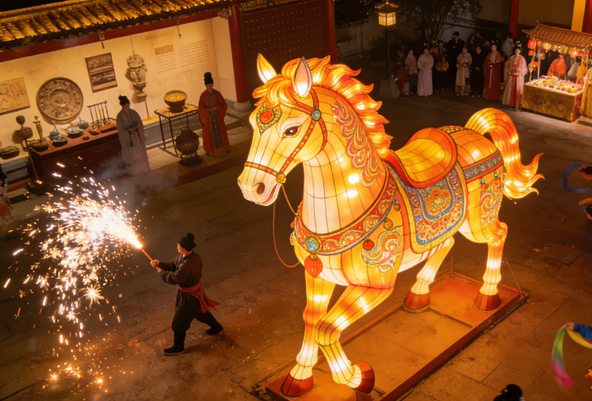
With the lantern market opening, ICH conveyed affection. On Zhanyuan Road in Nanjing, more than 50 ICH inheritors and lantern craftsmen set up stalls to welcome guests, and exquisitely crafted lanterns "bloomed" one after another, showing the charm of traditional craftsmanship. Among them, the special lanterns themed on horses were particularly eye-catching: the horse's body was plump, the mane was decorated with tassels, and the lamp base was matched with copper coins and pearls, implying the auspicious meaning of "immediate wealth", integrating traditional charm with modern aesthetics and being deeply loved by the public. After decades of inheritance and development, the folk lantern customs once along the Qinhuai River have now become a world-famous city cultural card, allowing the Spring Festival flavor of old Nanjing to be passed down from generation to generation in the flow of lights.
Going up the Yangtze River, the Spring Festival atmosphere in Nanchang, Jiangxi, was equally warm. The large-scale national style real-scene performance "Dream Back to Hongzhou" was staged stunningly. Red-hot molten iron was hit into the night sky again and again, with splashing iron flowers like meteor showers, complementing the gorgeous immersive real-scene stage, vividly reproducing the grand scene of "a night sky full of fireworks". The performance integrated ICH elements such as iron flower performance, Nuo dance and flying fire pot into the stage narrative, combined with modern stage art and light and shadow technology, clearly outlining the historical context of Nanchang from the prosperous Han and Tang dynasties to a heroic city, allowing the audience to feel the profoundness of traditional culture in the audio-visual feast, with an extremely warm on-site atmosphere.
From south to north, the Spring Festival flavor extended, and cultural gatherings lit up the Spring Festival. Inside Maoling Museum in Xingping, Shaanxi, the "Auspicious Heavenly Horses · Han Rhyme Welcomes the New Year" cultural gathering was held lively, marking the third consecutive year that the museum has held the "Spend the Spring Festival in the Museum" activity. With Han culture and "horse" cultural relics as the main line, the activity set up rich experience projects such as cultural relic check-in, Han Dynasty brick and tile rubbing, and pottery horse blank painting, allowing tourists to read history and enjoy the Spring Festival flavor through interesting interaction. During this year's Spring Festival holiday, Maoling Museum received a total of 27,937 tourists. The rich horse cultural relics in the museum vividly showed the important role of horses in the long history, and the ICH experience built a bridge between ancient and modern times, bringing new life to the thousand-year-old Han rhyme in the Spring Festival.
On the northern grasslands, the Spring Festival flavor was strong. On the fifth day of the first lunar month, a folk art tour "Horses Tread on Spring Breeze, Prosperous Age Sings Joyfully" was held lively on the streets of Guyang County, Baotou, Inner Mongolia. More than 50 local farmers, wearing colorful clothes and holding silk fans, danced the joy and expectation of the Spring Festival with the simplest dance moves. In the drum dance yangko performance, the elderly and the young performed on the same stage: the over-70-year-old performers moved nimbly and looked radiant, while the children followed closely to imitate and learn, and the ICH skills were quietly inherited in laughter and joy. A 10-meter-long float themed "Mongolian-Han Marriage Alliance" slowly passed by, with dragon and lion dances and stilt performances staged one after another. The drumbeats of Mongolian-Han cultural integration played the Spring Festival movement, depicting a beautiful picture of all ethnic groups celebrating the festival together.
As night fell, the night sky of Guyang became more bright. Hundreds of UAVs took off, transforming into auspicious shapes such as "success at once", with technological light and shadow complementing ancient ICH, drawing a touching footnote to the Year of the Horse Spring Festival. From Jiangnan lanterns to northern grassland yangko, from ICH performances to cultural gatherings, this Spring Festival, various regions inherited folk customs and conveyed warmth in various forms. It not only made people feel the strong Spring Festival flavor, but also allowed traditional Chinese culture to take root and thrive in the soil of the new era, injecting warm and strong cultural power into the new year.