China Completes Nation’s First Vessel-to-Grid Trial at Lianyungang Port
According to Xinhua News Agency, China’s inaugural vessel-to-grid bidirectional power exchange trial has been fully completed at Lianyungang Port in Jiangsu Province, with a fully electric harbour tug feeding electricity back into the port microgrid and filling the country’s technical gap in two-way energy interaction between battery-powered marine craft and onshore power networks.
The full-scale trial was jointly delivered by State Grid Lianyungang Power Supply Company and the Tugboat Branch of Lianyungang Port Group.
Yungang Electric Tug No.9, the fully electric vessel used for the demonstration, was linked to the port’s microgrid via shore power cables, with the entire process of reverse power transmission from the tug to the grid validated in real operational conditions. Recorded operational data shows the tug’s integrated energy storage system responds instantly to dispatching signals sent out by the microgrid, supplying stable power to run container quay cranes throughout the seven-hour test window, which delivered a total power output of 560 kilowatt-hours.
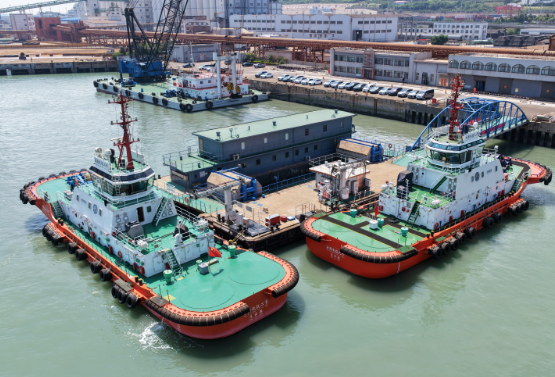
Engineers overcame technical barriers surrounding steady high-power charging and discharging under coastal conditions marked by high humidity and salt spray. A bespoke coordination device built around grid-forming control algorithms was deployed to enable seamless switching between power consumption and power generation modes once the tug is moored alongside the quay.
Comparisons have been drawn between this marine power scheme and established vehicle-to-grid technology for electric passenger cars. A single electric vehicle can only feed between seven and fifteen kilowatts back to the grid, a capacity framed as low-volume incremental supply, while the power output capacity of electric tugs delivers vastly greater energy throughput to shore-side infrastructure. Four fully electric tugs are now operational across Lianyungang Port, combining to form a mobile energy storage cluster with a total capacity of 20,000 kilowatt-hours, equivalent to a compact transportable power station capable of sustaining simultaneous operation for five large quay cranes.
Under existing supportive industrial policies, electric tugs store surplus electricity during off-peak grid demand periods and export stored power to the port network at peak hours to generate revenue. The operating model cuts overall energy expenditure for port operations and strengthens the resilience of regional power supply networks, bringing concurrent commercial and environmental benefits.
Moored vessels are transformed into flexible, adjustable mobile energy storage assets through the completed trial scheme. The project establishes a replicable operational template for low-carbon shipping transformation and broadens the range of water-based source-grid-load-storage application scenarios under the framework of new power system development.
Port authorities and power grid operators will advance further technical upgrades and scaled roll-out of vessel-to-grid hardware across coastal and riverine harbour facilities nationwide.