Next-Generation Intelligent Manufacturing Takes Centre Stage as China Advances New Industrialisation
According to state financial and industrial news outlets, a recent executive meeting of the State Council has identified next-generation intelligent manufacturing as the core development priority. Policy frameworks will ramp up delivery of industrial foundation reconstruction initiatives and high-quality upgrade schemes for key manufacturing supply chains, accelerate breakthrough research on core proprietary technologies, lift domestic energy and resource security capacity, and reinforce the resilience and stability of industrial chains.
A new wave of technological and industrial transformation is unfolding globally, with intelligent manufacturing standing as a central lever for high-quality industrial development. Major manufacturers across core industrial sectors are rolling out intelligent, green and integrated production systems to drive operational upgrades.
Advanced automation infrastructure can be seen across BMW Brilliance Automotive’s Tiexi plant in Shenyang, a facility spanning over two square kilometres. Thousands of industrial robots operate continuously across production lines, supported by more than 500 automated guided vehicles for intra-site material transport. Full-coverage 5G networks enable real-time AI monitoring of production workflows and potential safety hazards. The site incorporates all four core automotive manufacturing processes, with big data, 5G and digital twin technologies cementing its standing as a benchmark for digitalised vehicle production.
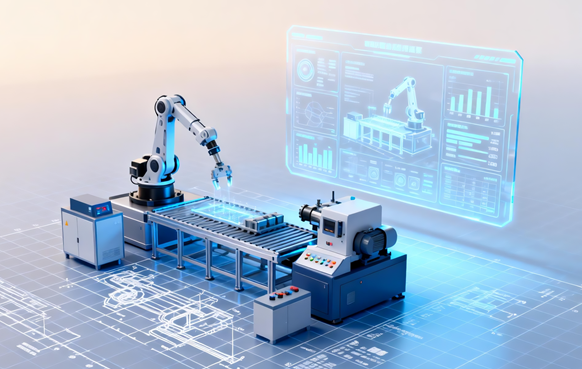
Intelligent manufacturing forms an indispensable pathway for advancing new industrialisation and building robust equipment and manufacturing sectors, alongside acting as a core engine for fostering new productive forces and securing competitive advantage in the next industrial revolution. Industry advisory bodies confirm intelligent manufacturing has evolved from isolated pilot projects to full-scale industry rollout, shifting from single-process technical upgrades to complete systemic construction, with clearer development trajectories delivering tangible support for advanced manufacturing development.
AI paired with industrial internet platforms will act as foundational strategic infrastructure for next-generation smart manufacturing. Cloud service providers have pioneered AI-powered master craft factories clustered around industrial zones, deploying vertical industrial large language models to equip frontline production staff with artificial intelligence capabilities and cultivate digital skilled operatives.
Boshan District in Zibo, Shandong Province, known nationwide as the Pump Capital of China, hosts a ninety-year-old electromechanical pump industrial cluster generating annual output exceeding 10 billion yuan, delivering mature industrial groundwork for large-scale industrial AI deployment. Local tech operators have built the country’s first AI master craft factory dedicated to electromechanical pump production, structured around five core functional zones including high-skilled craft studios, data workshops, digital training grounds, automated production workshops and central operation hubs. Integrated industrial intelligent agents and digital assistance tools resolve long-standing operational bottlenecks, lifting average production efficiency by 30 per cent and cutting pump selection lead times by 80 per cent for local manufacturers, establishing a recognised regional digital pump industrial brand.
Integrated System Solutions Accelerate Industrial Digital Rollout
China’s national intelligent manufacturing programme has undergone sustained implementation in recent years, yielding a tiered network of certified smart factories and a growing pipeline of landmark technical supply-side innovations, backed by refined national standard frameworks. End-to-end system integration solutions serve as a vital bridge connecting technological research and on-site industrial deployment.
The 2026 Intelligent Manufacturing System Solutions Conference has drawn together industry standardisation bodies, which confirm the sector now covers forty standardised application scenarios across five core production phases. Suppliers can assemble customised plant and enterprise-wide integrated solutions by combining modular components from centralised scenario and industry knowledge databases. This flexible delivery model has unlocked intelligent manufacturing adoption among small and medium-sized manufacturers, supporting mass-scale digital transformation across industrial segments.
Cross-disciplinary academic research highlights that next-generation intelligent manufacturing merges cutting-edge artificial intelligence with advanced production technology, delivering marked improvements in product quality, operational efficiency and production reliability. Full-process industrial optimisation enables more precise, rapid and consistent intelligent manufacturing frameworks.
Nearly one hundred domestically manufactured industrial robots developed by SIASUN Robot & Automation Co., Ltd. operate automated welding stations at Geely Automobile’s Yiwu production base in Zhejiang Province. Four years of targeted research and development have enabled large-scale deployment of home-grown robotic equipment within automotive body welding lines, marking a landmark technical breakthrough for domestic automation hardware within high-end vehicle manufacturing workflows.
SIASUN Robot & Automation Co., Ltd. focuses its core operations on intelligent manufacturing, holding proprietary intellectual property rights across three core product ranges: industrial robots, mobile handling robots and special-purpose robotic systems, alongside three complete automation solution suites covering welding, assembly and logistics handling. Hardware-software collaborative innovation and deep AI integration will remain central focal areas for the industrial automation sector over coming cycles.
Industry research bodies propose targeted development measures to expand the uptake of intelligent manufacturing integration solutions, prioritising deep fusion between next-generation artificial intelligence and advanced manufacturing. Support will be directed towards nurturing a cohort of specialist suppliers capable of delivering end-to-end integrated innovation, developing a mature industrial service ecosystem to facilitate enterprise-wide digital upgrades.
Nationwide Industrial Uplift Driven by Integrated Intelligent Manufacturing
Deep integration between artificial intelligence and real industry is reshaping manufacturing workflows and economic structures, forming a decisive factor in industrial upgrading and reshaping global industrial competition frameworks.
High-speed AI visual inspection equipment deployed at a pharmaceutical production base in Northeast Pharmaceutical Group Co., Ltd. captures seventy-two high-definition images of each liquid vial within 0.1 seconds, with millisecond-level intelligent analysis identifying micro foreign particles, bottle cracks and abnormal liquid levels. The system delivers inspection throughput of 550 vials per minute with an accuracy rate of 99.99 per cent. Automated filling, sealing, packaging and robotic palletising systems deliver fully automated, transparent and controllable end-to-end pharmaceutical production.
Intelligent manufacturing applications continue expanding across automotive, pharmaceutical, electronics and high-end equipment sectors nationwide. Artificial intelligence and industrial internet infrastructure are reshaping manufacturing models and industrial competition dynamics across all core industrial verticals.
Official industrial data records 35,000 entry-level smart factories, more than 8,200 advanced-level smart factories and over 500 elite-level smart facilities operating across the country, with fifteen enterprises selected for national flagship smart factory cultivation schemes. New industrial models including shared construction machinery manufacturing, modular automotive production and agile customised household appliance manufacturing have been established. National tiered smart factory cultivation drives an average 47 per cent fall in product defect rates and a 38 per cent reduction in product research and development cycles.
Regional authorities are building industrial frameworks anchored on advanced manufacturing, targeting high-end, intelligent and green development pathways to deepen new industrialisation progress. Dalian, a core industrial hub in northeast China’s old industrial base, is capitalising on digital economic expansion to push forward industrial digital transformation. The city has cultivated five elite-grade smart factories, eighty-eight advanced-grade smart facilities and 109 provincial-level digital workshops, with six projects selected for national open tender intelligent manufacturing solution initiatives. Forty-three provincial industrial internet platforms have been commissioned, linking two million sets of industrial equipment and delivering full coverage of key regional industrial clusters.
National industrial advisory bodies outline multi-layered development pathways for next-generation intelligent manufacturing. Centralised top-level design frameworks will be reinforced, with development focus concentrated on smart factory infrastructure and intelligent production equipment to build world-class production capacity and domestic advanced machinery ecosystems. Parallel work will advance proprietary technical strengths, complete industrial digital ecosystems and supporting policy mechanisms to underpin sustained intelligent manufacturing advancement.
Next-generation intelligent manufacturing will expand its scope to encompass smart production, intelligent equipment and digital industrial services as artificial intelligence technologies embed deeper within production workflows. Early national intelligent manufacturing policies centred on on-site production upgrades, delivering a global network of digitalised factories. Upcoming development cycles will prioritise research and production of proprietary intelligent equipment and finished goods, strengthen cross-compatibility between hardware and software, address core bottlenecks in foundational industrial artificial intelligence technology, and balance forward-looking technical research with widespread industrial adoption. Targeted digital transformation roadmaps will be rolled out for distinct industrial sectors, fostering a pipeline of innovative production models and formats to drive comprehensive upgrading of domestic industrial systems.