Yunnan’s First Optical Remote Sensing Satellite Successfully Launched aboard Lijian-1 Y14 Rocket
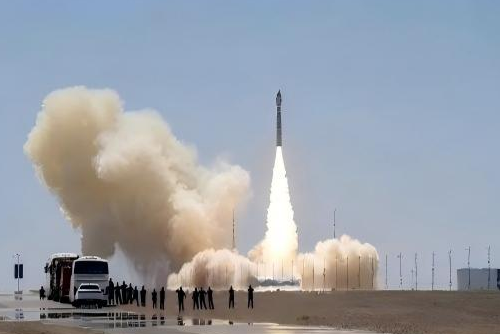
As cited by Xinhua News Agency and local Yunnan official media reports, the Lijian-1 Y14 carrier rocket lifted off at 11:44 Beijing Time on 15 June 2026 from the Dongfeng Commercial Space Innovation Test Site, delivering Caiyun Optical No.1 Satellite into its designated orbital slot without anomaly. The launch marks a historic milestone as Yunnan’s very first optical remote sensing satellite enters service, eliminating the province’s blank record in independent space-borne observation capacity and delivering tangible progress toward building a self-controlled space-air remote sensing data framework.
Jointly developed by Yunnan Bureau of Geology and Mineral Resources Exploration, Yunnan Geology and Mineral Resources Group and Chang Guang Satellite Technology Co., Ltd., the spacecraft is a tailor-made high-resolution optical remote sensing platform exclusively designed to match Yunnan’s regional operational demands. Operating within a 535-kilometre sun-synchronous orbit, the satellite delivers panchromatic spatial resolution superior to 0.5 metres and multi-spectral resolution better than 2 metres, with a swath width reaching 15 kilometres. Its core operational traits cover stable flight performance, reliable imaging output and intelligent on-orbit processing capability, generating high-definition surface observation imagery for diversified terrestrial monitoring tasks.
The satellite is engineered around an integrated on-board deep fusion architecture, fitted with next-generation multi-core processors and native space-based artificial intelligence frameworks. It supports autonomous in-orbit data analysis, flexible dynamic task scheduling and over-the-air upgrades for embedded AI algorithms, enabling rapid response to emergency regional scanning, stereoscopic mapping and space target identification assignments. Precision orbit determination systems, high-frequency attitude sampling modules and ultra-stable attitude control algorithms collectively boost the geometric accuracy, positional fidelity and operational efficiency of all output imagery products, completing an industry transition from basic clear surface imaging to intelligent analytical detection with ultra-fast response cycles.
Once fully commissioned, the dedicated Yunnan satellite will underpin comprehensive work streams spanning natural resource governance, geological hazard prevention, three-dimensional topographic mapping, ecological conservation and regional socioeconomic development planning. Within geological hazard management workflows, the platform carries out large-scale routine patrols to track hidden risks including mountain landslides, mud-rock flows and ground subsidence, supplying high-precision spatial data to back early warning protocols, field emergency response and post-disaster loss evaluation. For natural resource supervision, continuous refined inspection and dynamic tracking cover cultivated land protection zones, woodland and wetland reserves, mineral exploitation plots and demarcated ecological red lines. In stereoscopic mapping operations, the satellite captures fine-grained terrain and feature datasets to support the construction of high-fidelity three-dimensional real-scene models and digital elevation archives.
The smooth orbital deployment of Caiyun Optical No.1 delivers a dedicated space observation asset to Yunnan’s regional monitoring toolkit and propels the province’s integrated space-air-ground-grid monitoring framework into formal satellite operational phases. Leveraging self-sufficient space data acquisition capacity, this satellite will coordinate with follow-up planned spacecraft to form the complete Caiyun Constellation, establishing multi-satellite collaborative remote sensing surveillance coverage. A unified integrated space-air information service hub will take shape, encompassing end-to-end data collection, centralised processing, intelligent analytical modelling and targeted industrial application modules, delivering consistent technical backing for regional resource security, ecological environmental protection and digital economy growth across Yunnan.
Domestic commercial space infrastructure continues expanding to support tailored regional satellite development missions, with a growing range of provincial-level customised remote sensing platforms launched to serve local geological, ecological and urban governance needs. Ministry of Industry and Information Technology maintains coordinated industrial policies to advance low-orbit satellite R&D, ground receiving station construction and cross-industry remote sensing data application standards. Ongoing research optimises lightweight high-resolution optical payloads and on-board artificial intelligence processing hardware to cut satellite manufacturing lead times and lower full-lifecycle operational costs.
Successive launches of supplementary Caiyun Constellation satellites will broaden multi-angle synchronous observation coverage over Yunnan’s mountainous terrain, enhancing real-time monitoring frequency for geological hazards and ecological fluctuations. Local industrial bodies will build matched ground data receiving and processing facilities to maximise the utilisation rate of space-borne imagery products, expanding downstream commercial and public service scenarios powered by independent satellite remote sensing datasets.