China Accelerates Nuclear Fusion R&D to Drive Future Energy Revolution
Against the backdrop of accelerating global energy system transformation and in-depth advancement of green and low-carbon transition, nuclear fusion is regarded as the "ultimate solution" to future energy problems due to its advantages of abundant fuel sources and environmental friendliness. China has been accelerating its R&D and industrial layout in related technologies, with continuous breakthroughs in key areas, China Energy News reported.
Experts point out that during the "15th Five-Year Plan" period, nuclear fusion industrialization should lead future development, accelerating the formation of a 100-billion-yuan advanced fusion manufacturing industrial cluster to inject strong momentum into the energy revolution.
China’s nuclear fusion research is moving from "single-point breakthroughs" to "system capability improvement". At the 2026 Spring Nuclear Energy Sustainable Development Forum held on April 17, Liu Ye, Secretary of the Party Committee of the Southwestern Institute of Physics of the China National Nuclear Corporation, introduced that the new-generation artificial sun "China Circulation No. 3" achieved a "double 100 million degree" breakthrough last March, with nuclear temperature reaching 117 million degrees Celsius and electron temperature 160 million degrees Celsius.
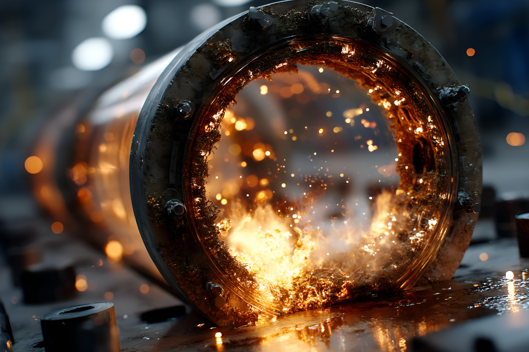
Meanwhile, the Institute of Plasma Physics of the Chinese Academy of Sciences has made continuous progress in steady-state operation. Its developed "East Tokamak" successfully achieved steady-state operation at 100 million degrees Celsius for 1066 seconds last year, simulating long-pulse conditions required for future fusion reactors. Energy Singularity Energy Technology Co., Ltd. also made achievements, with its world’s first full high-temperature superconducting tokamak device "Honghuang 70" achieving 1337 seconds of steady-state long-pulse plasma operation.
The industrial driving effect of nuclear fusion is gradually being released. Zhang Li, Member of the Standing Committee of the Party Committee and Deputy General Manager of China Power Engineering Consulting Group Co., Ltd., noted that "nuclear fusion energy" has been included in China’s key cultivation directions during the "15th Five-Year Plan" period. China’s first Fusion Industry Alliance, established in November 2023, has gathered more than 260 enterprises by the end of last year.
Li Jiangang, Academician of the Chinese Academy of Engineering and Researcher at the Institute of Plasma Physics of the Chinese Academy of Sciences, emphasized the importance of building a complete industrial chain. He said nuclear fusion technology has significant technological spillover effects, driving the development of high-end manufacturing fields such as superconducting materials. Thanks to participation in the ITER project, China has achieved independent development of superconducting materials, with Western Superconducting Materials Technology Co., Ltd. becoming a global leader.
China Nuclear Energy Association released the "China Nuclear Energy Development Report (2026)" on April 17, proposing to fully promote the "thermal reactor-fast reactor-fusion reactor" three-step strategy. Liu Lu, Deputy Director of the National Nuclear Safety Administration, stressed the need to strengthen safety logic and improve the regulatory system, ensuring high-quality development of the nuclear fusion industry as it moves towards engineering application.