Intelligent Manufacturing Leads China’s Industrial Upgrade, Forging a Strong Manufacturing Power
Industrial upgrading centered on intelligent manufacturing has become a core grasp and strategic fulcrum determining the quality and competitiveness of the modern industrial system. At the recently held 2026 CCID Forum, Su Bo, Deputy Director of the Strategic Advisory Committee for Building a Manufacturing Power and Director of the National Expert Committee on Intelligent Manufacturing, stated that China has clearly taken intelligent manufacturing as the main direction of attack.
According to CCID News, China has gradually formed a distinctive path of parallel advancement of digitalization, networking and intellectualization, successfully achieving the strategic goal of the "first step" in building a manufacturing power. The overall level of the manufacturing industry has shifted from being dominated by the mid-to-low end to ranking among the mid-to-high end in many important fields, with world-leading levels in 5G communication equipment, high-speed rail equipment, shipbuilding, new energy vehicles, wind power and solar power new energy equipment.
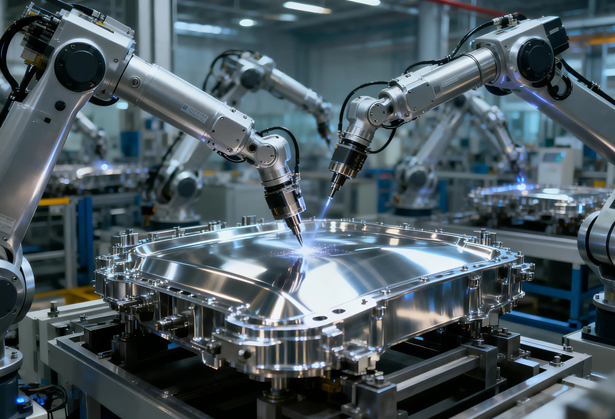
By the end of last year, the digital transformation coverage rate of China’s industrial enterprises above designated size reached 89.6%, and the popularization rate of digital equipment reached 57.7%. As an important carrier of intelligent manufacturing, the production and sales of industrial robots exceeded the sum of those in other countries, according to the Ministry of Industry and Information Technology.
China’s core technological innovation capacity has been continuously enhanced, and its supply capacity for intelligent manufacturing has been greatly improved. In terms of core technology research, breakthroughs have been made in system solutions for the "new three things" products—photovoltaic, power batteries and electric vehicles. In information infrastructure construction, China has fostered more than 340 influential industrial internet platforms.
With the in-depth integration of artificial intelligence and the manufacturing industry, new models and formats of intelligent manufacturing have expanded from "point breakthroughs" to "comprehensive development". Haoyang Environment Co., Ltd. has built an integrated data management and cost control platform relying on Inspur Haiyue industrial software system, reducing raw material loss rate and production cost by more than 5% each.
"Intelligent manufacturing promotes industrial production towards distributed, non-standard and customized directions, thus realizing large-scale personalized customization," said Wang Yiming, former Deputy Director of the Development Research Center of the State Council. He added that it not only greatly improves production efficiency, but also accurately controls technological processes and energy consumption, promoting the green transformation of manufacturing methods.
At the 11th plenary session of the State Council held on March 16, "accelerating the development of a new generation of intelligent manufacturing" was listed as a key task. Su Bo noted that the "newness" of the new generation lies in autonomy, involving product R&D relying on virtual simulation, generative design and digital twins, and production forming a closed loop of "perception-decision-execution-feedback".
Su Bo emphasized that China will unswervingly adhere to intelligent manufacturing as the main direction, striving to basically popularize digital and networked manufacturing in industrial enterprises above designated size by 2030, and make China a world leader in the application of new-generation intelligent manufacturing technology by 2035. Wang Yiming added that implementing the "Artificial Intelligence +" initiative will empower the transformation and upgrading of traditional industries.