China’s Embodied Intelligence Makes Strides: Commercialization Gains Momentum with Expanding Application Scenarios
BEIJING, April 11– China has achieved phased breakthroughs in the commercial and large-scale application of artificial intelligence, with its R&D capacity advancing by leaps and bounds, industrial scale growing rapidly, and global competitiveness continuously enhancing, marking a new stage of technological innovation and industrial development.
Embodied intelligence, a key segment of AI development, serves as a prominent illustration of this progress. According to a report released by the Development Research Center of the State Council, the market scale of China’s humanoid robots exceeded 8.5 billion yuan in 2025, accounting for over 50% of the global total. With the independent development and widespread application of multimodal large models, embodied intelligence has made remarkable progress in processing various types of information such as vision, touch and voice, evolving continuously through interaction to become more intelligent and dexterous.
Domestic enterprises have also achieved global recognition in this field. Xingdong Jiyuan, a leading Chinese embodied intelligence enterprise, recently won three global first prizes in peeling oranges, unlocking locks and folding socks at Benjie's Humanoid Olympic Games, a top international competition in embodied dexterous operations. "Our self-developed VLA embodied model enables robots to complete complex tasks with high precision," said Chen Jianyu, founder of Xingdong Jiyuan, noting that the company’s joint research with Stanford University has also surpassed international giants like Google and NVIDIA in related rankings.
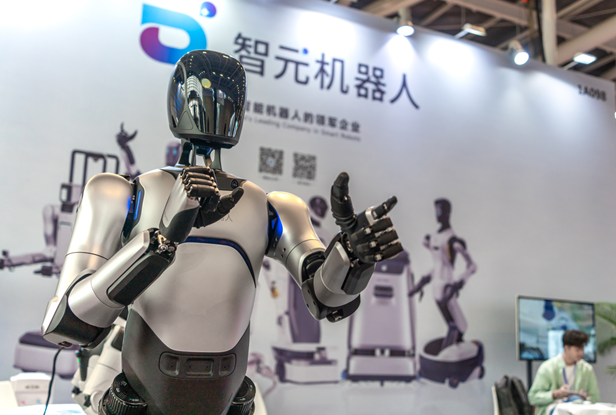
While advancing rapidly, the embodied intelligence industry also faces in-depth challenges including technological integration, data sharing and lagging governance. As technological R&D moves into a critical phase of application innovation and industrial development – from "1 to 10" and "10 to 100" – application scenarios have become an urgent priority, acting as a "practical drill" for the whole society to transform new technologies from laboratories to application fields, and from samples to products and commodities.
Across China, exploration into application scenarios is deepening. In the industrial sector, embodied intelligence has extended from handling and inspection to high-value links such as precision assembly and flexible manufacturing, with the penetration rate in key manufacturing scenarios expected to rise further. In the service industry, it is accelerating its deployment in elderly care and public services. Leading domestic enterprises have carried out in-depth cooperation with international platforms in chips and simulation training, integrating their technological ecology into the global system.
Beijing, in particular, has taken the lead in promoting industrial development. The Beijing Municipal Science and Technology Commission and Zhongguancun Science and Technology Park Management Committee have launched a three-year cultivation plan, aiming to build a 100-billion-yuan industrial cluster by 2027. "We will construct an embodied data collection platform and open 3 million high-quality data sets by the end of this year to address data bottlenecks," said Han Jian, director of the Information Technology Department of the Beijing Municipal Science and Technology Commission.
Efforts are also being made to strengthen the coordination of systems and technologies, refine scenario lists, and build a closed-loop mechanism to promote supply-demand docking. A sound standard and governance system is taking shape, clarifying safety and governance norms in hardware, software, communication, data and human-computer interaction, while ecological co-governance is guiding enterprises to strengthen the layout of core algorithm intellectual property rights, fostering a sound development ecosystem.