China’s New Energy Storage Leads Global Market, Driven by Policy and Innovation
BEIJING, April 8, 2026 — With over 800 exhibitors and six themed pavilions, cutting-edge technologies and products such as solid-state batteries, AI large models and high-capacity cells made a collective appearance at the 14th Energy Storage International Summit and Exhibition (ESIE 2026). The gathering of global core forces in the energy storage industrial chain has become a key window to observe the development of China’s new energy storage industry, according to Guangming Net.
Driven by improved policy mechanisms, technological breakthroughs and booming market demand, China’s new energy storage industry is deeply integrating into the construction of a new power system, serving as an important pillar for new energy consumption and green low-carbon development.
The China Energy Storage Alliance (CNESA) released the "Energy Storage Industry Research White Paper 2026" at the summit, stating that by the end of 2025, China’s cumulative installed capacity of new energy storage reached 144.7GW, accounting for 51.9% of the global market — the first time it has exceeded half, indicating China’s transformation from a "follower" to a "leader" in the global energy storage sector.
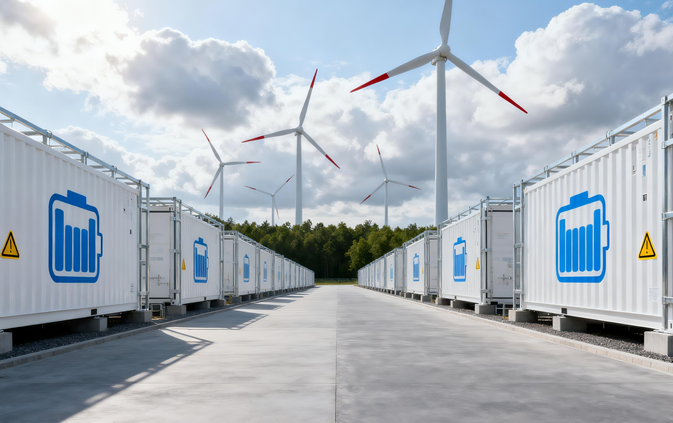
In terms of installed structure, new energy storage accounts for more than two-thirds of China’s total power energy storage scale, a 45-fold increase from the end of the 13th Five-Year Plan period. In 2025, the newly commissioned scale reached 66.4GW/189.5GWh, with power and energy scales increasing by about 52% and 73% year-on-year respectively, ranking first in the world for four consecutive years, Xinhua News Agency reported.
Notably, this growth was achieved as policy shifted from "mandatory energy storage allocation" to "market-oriented energy storage use", reflecting stronger endogenous momentum and the leading role of market mechanisms. In early 2025, the National Development and Reform Commission (NDRC) and the National Energy Administration (NEA) issued a notice abolishing mandatory energy storage requirements for new energy projects, turning energy storage from a "cost item" into a "value item" in market competition.
Policy support has continued in 2026. In January, the NDRC and NEA jointly issued a notice establishing a national-level capacity price mechanism for grid-side independent new energy storage, hailed by the industry as a "reassurance" that has boosted social capital investment enthusiasm by ensuring stable revenue expectations for energy storage power stations.
Listed companies’ performance confirms this trend. According to Securities Times, as of early April 2026, 23 energy storage concept stocks achieved year-on-year growth in net profit attributable to parent companies in 2025, showing improved profitability across the industrial chain.
Liu Deshun, Chief Engineer of the NEA, stated at ESIE 2026 that efforts will be made to improve market mechanisms, refine the capacity price system and establish reliable capacity compensation mechanisms to guide the sound development of new energy storage. Chen Haisheng, Chairman of CNESA, noted that China, the US and Europe remain the world’s largest energy storage markets, with China leading in new installations.
Industrial insiders hold positive expectations for 2026. Industrial Securities’ research report predicts booming growth in all energy storage segments driven by policy, rigid demand and economic benefits, with energy storage becoming a key support for AI data centers. KPMG’s "Global Technology Report 2026: Energy Industry Insights" points out that new energy storage and solid-state batteries will see explosive growth, transforming into a key element of the new power system.
With the deepening of power market reform and continuous technological breakthroughs, new energy storage has become an indispensable force in ensuring energy security and promoting green low-carbon transformation, weaving a solid foundation for China’s high-quality development and global energy transition.