An industrial park with a total investment of RMB 1 billion has landed in Alashankou, as Sichuan builds a westward cross-border logistics and trade node
According to information released by Sichuan Provincial State-owned Assets Supervision and Administration Commission on November 11, 2026, on November 7, Luhai Yungang Co., Ltd., an affiliate of Sichuan Port and Investment Group, signed an investment agreement with the People’s Government of Alashankou City, Xinjiang Uygur Autonomous Region, to jointly develop the Alashankou Cross-border Logistics and Bonded Processing Industrial Park. Covering a planned land area of more than 800 mu, the project involves a total investment of about 1 billion yuan, making it the largest industrial investment project launched by Sichuan at Xinjiang ports to date.
As China’s land gateway opening to Central Asia, Alashankou serves as a key passage port for China-Europe and China-Central Asia freight trains. Leveraging the port’s geographical advantages and preferential policies of the comprehensive bonded zone, the project will build dedicated railway lines, grain and oil silos, container yards, bonded distribution warehouses and a cross-border highway distribution center. Supporting facilities for block train transshipment of iron ore, grain and containers will also be constructed. Its core businesses include railway logistics operation, bulk commodity trade and integrated cross-border supply chain services for Sichuan-manufactured goods.
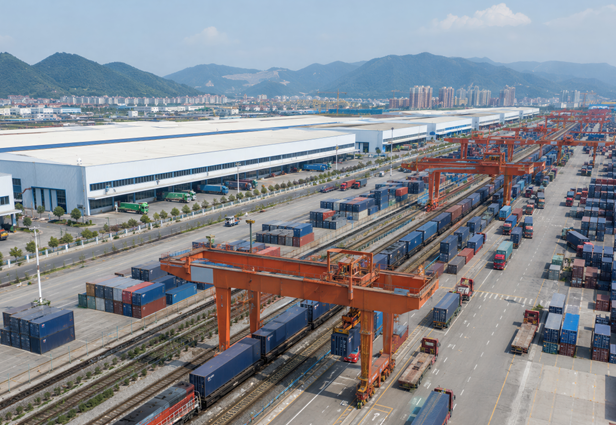
Upon operation, iron ore and grain from Central Asia can be transshipped, screened and stored in the park. Eligible goods will enter the bonded zone for processing trade. Equipment and electronic products manufactured in Sichuan will be consolidated, grouped and declared for export here. Adopting an on-site transshipment model compatible with broad-gauge tracks overseas and standard-gauge tracks domestically, the project eliminates repeated lifting and transshipment, saving more than 50 million yuan annually on lifting and short-distance haulage costs. Compared with conventional China-Europe freight train routes, the transit time for exported goods can be cut by 3 to 5 days. The efficiency of container grouping, drop-and-hook transport and customs clearance connection for cross-border highway shuttles is expected to rise by over 25%, while truck dwelling time at the port will drop by nearly 30%. The road-rail intermodal transport model will further reduce the cost of a single shipment. A representative of Luhai Yungang Co., Ltd. stated that after reaching full capacity, the project is projected to generate an annual output value of over 5 billion yuan and handle an annual comprehensive throughput of more than 6 million tons.
Economic and trade exchanges between Sichuan and Central Asia keep expanding. Sichuan-made new energy vehicles, electronic information products, equipment manufacturing goods, photovoltaic and energy storage products continue to enter Central Asian markets. High-quality grain, oil, livestock products and mineral resources from Kazakhstan are transported into China via freight trains. In 2025, the trade volume between Chengdu and Kazakhstan exceeded 250 million US dollars, a year-on-year increase of over 100%. In 2026, the number of China-Central Asia freight trains departing from Chengdu surged more than four times year on year. Two new all-rail routes directly to Turkmenistan were launched within the year, and return freight trains from Kazakhstan to Chengdu have achieved regular operation.
Sichuan Port and Investment Group previously signed a bilateral investment cooperation agreement with Kazakhstan Temir Zholy, the national railway company of Kazakhstan. Under the deal, the China (Sichuan)-Kazakhstan Logistics and Trade Cloud Port will be built in Kokshetau of Kazakhstan, and the Kazakhstan Chengdu Inland Port Terminal will be constructed in Chengdu. The combined total investment of the two facilities stands at around 2 billion yuan. The inland hub in Chengdu, the port node in Alashankou and the overseas base in Kazakhstan will form a three-point linkage system, opening up a cross-border logistics and trade corridor connecting the industrial hinterland of Sichuan with markets in Central Asia and Europe.
热门内容推荐