Phase three of Haiyang nuclear power project in Shandong starts construction
According to State Power Investment Corporation, on 31 October, the nuclear island of Unit 5 at the Haiyang nuclear power station in Shandong carried out its first concrete pour, marking the official start of phase three works. The scheme forms a key project under China’s 15th Five‑Year Plan.
The facility sits in Haiyang, Shandong Province. It ranks among the world’s first batch of Generation III nuclear power stations and is the first nuclear plant built in Shandong. The site is planned for six million‑kilowatt reactor units spread across three development phases. Units 5 and 6 in the new phase adopt the domestic CAP1000 Generation III passive pressurised water reactor design, and represent the first nuclear project to break ground in Shandong during the 15th Five‑Year Plan period.
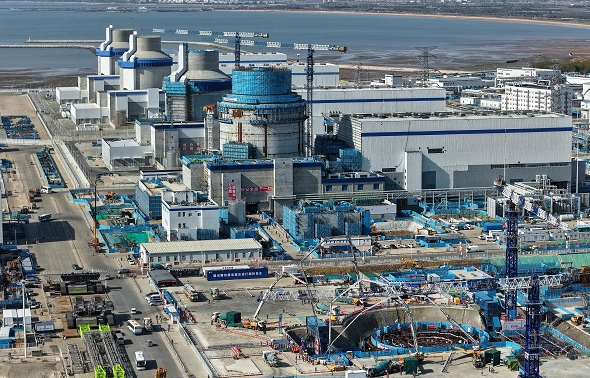
The nuclear island contains the reactor building, where the containment, reactor core and major plant equipment rest on a single concrete raft foundation. This foundation must sustain static loads as well as extreme forces triggered by seismic events or accident scenarios, forming the primary safety base of the station. Standards governing this mass concrete pour are stricter than those applied to conventional civil structures. Around 6,626 cubic metres of concrete are being laid for Unit 5’s nuclear island base in one continuous pour, with the operation expected to run for nearly 62 hours.
The launch of phase three takes the Haiyang site into a stage of simultaneous multi‑unit construction and operation, as clustered development and diversified deployment of nuclear energy proceed. Once Units 5 and 6 are commissioned, Haiyang will become the world’s largest nuclear complex built entirely around passive pressurised water reactor technology. Its annual power output will reach 60.9 billion kilowatt‑hours, sufficient to meet the domestic electricity demand of 54 million residents. The development will save roughly 18.56 million tonnes of standard coal and cut carbon dioxide emissions by 48.63 million tonnes each year, while supplying heat across an area exceeding 150 million square metres, covering 25 county‑level cities.
热门内容推荐