Angang Group deploys AI agents to digitise core steel operations
According to Angang Group Corporation Limited, published 19 October 2026, the group has rolled forward its digital transformation programme, developing more than 100 self-built AI agents, with 53 agents formally launched. Seventeen categories of AI use cases cover core links including production scheduling, process costing and equipment management.
The group has established an AI delivery framework built on data penetration, intelligent collaboration and process reconfiguration. The application of these tools has delivered annual cost savings of more than 17 million yuan.
The platform connects six data dimensions covering accounts, products, organisational units, periods, metrics and measurement standards, and spans key production processes such as coking, sintering, pelletising and pig iron output. It supports multi-layered analysis of raw material, fuel, power and manufacturing expense data, including unit prices, consumption rates and unit costs. Comparative data for monthly, cumulative, budget and forecast benchmarks is accessible on demand, with cost optimisation traced to individual processes and product lines. Process cost analysis alone accounts for annual savings of over 10 million yuan.
AI and data capabilities are embedded within production control workflows under a graded data monitoring system, delivering round-the-clock alerting. Automatic prompts for remedial action are generated once operational deviations are graded, and key production information is distributed on a daily basis.
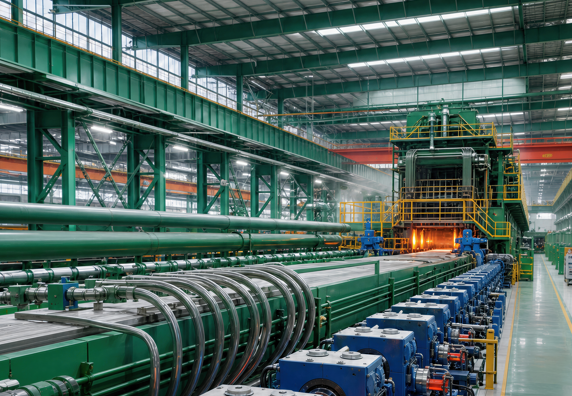
Angang Group has worked closely with Yonyou Network Technology to integrate AI into disparate legacy systems and core manufacturing workflows. The technology can pre-empt equipment faults, automatically adjust production schedules and flag quality risks ahead of incidents. Operational systems have shifted from static record-keeping to predictive monitoring and coordinated response.
AI tools support energy optimisation, scheduled downtime management, quality oversight and cost analysis. Equipment maintenance has moved from reactive repair to pre-emptive warning, while scheduling workflows are configured so that issues are surfaced automatically rather than identified manually. AI agents and digital workers operate continuously, handling more than 2,000 business tasks each day.
The group has trained nearly 300 digital champions from across operational teams to support in-house AI development. Agents built by staff support production control, vertical business workflows and general knowledge services. A dedicated equipment fault diagnostic assistant codifies specialist maintenance knowledge to serve roughly 1,000 frontline inspection staff. Annual token consumption stands at 18 billion, with four million user dialogue sessions logged each year.
Angang Group will continue advancing high-end, intelligent and low-carbon development across its steel operations.
热门内容推荐