Three Guangdong Provincial Key Transport Projects Reach Construction Milestones
Three provincial key transport projects under Guangdong Communications Group completed or advanced key construction nodes around the National Day holiday, according to the Guangdong Provincial State-owned Assets Supervision and Administration Commission website.
Guangzhou–Zhaoqing Expressway Expansion: Xinxing River Grand Bridge Completes Traffic Switchover
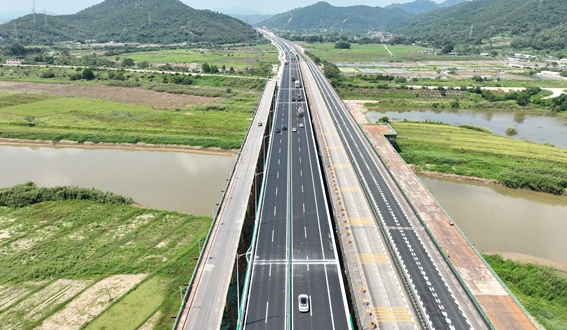
On September 29, the Xinxing River Grand Bridge, a control project of the Guangzhou–Zhaoqing Expressway expansion, completed a traffic switchover, with existing traffic smoothly moved to the newly built left-side bridge. During the National Day holiday, traffic on the new left-side bridge ran smoothly, and demolition of the old bridge did not affect passage.
According to the website of the Guangdong Provincial Department of Transport, the bridge is located at the junction of Liantang and Xinqiao towns in Gaoyao District, Zhaoqing. The left-side bridge had previously completed closure of its continuous rigid-frame girder and ancillary works; after the switchover, the right-side main bridge was closed for demolition and reconstruction. The bridge is 1,227 meters long and crosses the east and west dikes and main channel of the Xinxing River. It uses a separated new left-side bridge and a demolition-and-reconstruction approach for the old right-side main bridge. For complex geological and hydrological conditions, the project team used pre-grouting consolidation, high-pressure jet grouting and double-layer steel casing follow-up in pile foundation work, and applied intelligent diamond form travelers in continuous rigid-frame girder construction.
The Guangzhou–Zhaoqing Expressway expansion is 51.1 kilometers long and will expand the existing four- and six-lane road to eight lanes, with completion expected in 2027. The project will next advance demolition and reconstruction of the old bridge, girder construction, and pavement and ancillary facilities.
Pingyuan–Wuping Expressway: Qigushan Extra-Long Tunnel Begins Two-Way Excavation
On October 1, the left tube at the entrance portal of the Qigushan Tunnel on the TJ2 section of the Pingyuan–Wuping Expressway was successfully holed through for excavation. On October 6, the left tube at the exit portal on the TJ3 section was also holed through for excavation, starting two-end, two-way excavation of the Qigushan Extra-Long Tunnel. During the National Day holiday, more than 980 workers, over 460 pieces of machinery and equipment, and 55 work faces remained in continuous operation across the project.
Qigushan is a control project of the Pingyuan–Wuping Expressway. Its left tube is 4,806 meters long and its right tube 4,810 meters, with a maximum burial depth of 281 meters. According to the department’s website, Grade IV and V surrounding rock accounts for 57.5 percent of the tunnel, which crosses two fault fracture zones and passes beneath two rivers. The project uses a “one tunnel, twelve production lines” full-process mechanized construction model, with excavation, support and mucking carried out by coordinated intelligent equipment. The Pingyuan–Wuping Expressway is 42.8 kilometers long, with four lanes in each direction, a design speed of 100 kilometers per hour and a bridge-tunnel ratio of 46.84 percent. It is planned to open in 2029 and will become Guangdong’s sixth provincial expressway corridor to Fujian. The project will continue tunnel excavation and overall construction to meet annual targets.
Shiziyang Channel Connecting Section: Nanzhong Bridge Completes Steel Deck Panel Assembly
On October 7, the Nanzhong Bridge widening project in the Shiziyang Channel connecting section completed assembly of all 258 steel bridge deck panels, creating conditions for subsequent lightweight ultra-high performance concrete deck paving.
According to Nanfang News Network, Nanzhong Bridge is located between Nansha District, Guangzhou, and Huangpu Town, Zhongshan, crossing the Hongqili Waterway. It is a control project on the Guangzhou–Zhongshan–Jiangmen Expressway and is 775 meters long. The widening project is the world’s first widening of a long-span concrete cable-stayed bridge with a central cable plane. Without removing the original bridge towers, replacing stay cables or altering the foundations, the project team used eight C-shaped intelligent trolleys straddling the bridge deck to form a stable work platform and widened both sides by 2.25 meters each, integrating the new and old bridge structures. Along with the 258 steel deck panels, 482 sets of steel filler blocks, 770 curved node blocks and 770 steel diagonal braces were installed. For narrow box-girder interiors and steel-concrete connection challenges, the team developed an in-box rail transport system using small transporters to move filler blocks between diaphragms, with pulley and electric hoist traction for precise positioning. After widening, the bridge will be expanded from six lanes to eight lanes to connect with the Shiziyang Channel under construction. The project will next accelerate bridge deck paving.
The three projects involve internal road network capacity in the Guangdong-Hong Kong-Macao Greater Bay Area, a provincial border corridor to Fujian, and a link to the cross-Pearl River Estuary channel. Guangdong Communications Group said it will maintain autumn construction momentum, adhere to safety and quality requirements, and push to complete annual targets.
热门内容推荐