China’s first large-scale 18MW offshore wind turbine project fully commissioned
According to China General Nuclear Power Group, the 2GW Fanshi offshore wind farm in Yangjiang, Guangdong, reached full operational capacity on 24 September. It marks the country’s first large-scale deployment of 18-megawatt ultra-large offshore wind turbines, alongside China’s first 500kV intermediate reactive power compensation station built for an offshore wind site.
The Fanshi project sits in waters south of Nanpeng Island in Yangdong District, Yangjiang, and comprises two 1GW sub-projects. The farthest point of the site lies 81 kilometres from the shore, with a maximum water depth of 53 metres. A total of 131 wind turbines have been installed, of which 33 units are the 18MW offshore turbines, the largest model deployed in bulk across China.
The 18MW turbine has a rotor diameter of 292 metres and a swept area of roughly 66,000 square metres, equivalent to nine standard football pitches. At full load, one rotation of the rotor generates around 43 kilowatt-hours of electricity, enough to supply an average household for nine consecutive days. A single unit can produce 56 million kilowatt-hours of power annually. Mass roll-out of this turbine reduces the number of foundation positions, cutting expenditure on subsea cables, offshore foundation construction and sea area occupation, and driving down the levelised cost of offshore wind power.
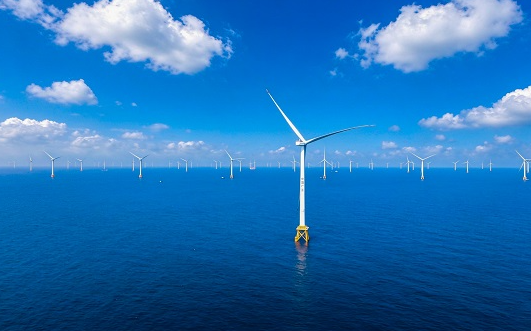
Lifting oversized components in deep water presents major technical challenges for offshore construction. The Fanshi Phase 1 offshore booster station weighs 6,168 tonnes, while the complete 18MW turbine assembly exceeds 1,500 tonnes during hoisting. These large structures are highly vulnerable to wind, requiring tight control over vessel operations, component stability and millimetre-level positioning accuracy. The project team completed heavy marine transportation and installation work within narrow weather windows, developing replicable full-set construction techniques for ultra-large equipment in deep waters.
The 500kV intermediate reactive power compensation station establishes a new model for stable long-distance grid connection of large-capacity wind power. It addresses technical constraints for gigawatt-scale offshore wind farms, including long transmission distances and substantial voltage losses far from shore.
Upon full commissioning, the project delivers more than 6.6 billion kilowatt-hours of clean electricity to the grid each year. This cuts coal consumption by around 1.92 million tonnes and reduces carbon dioxide emissions by 5.1 million tonnes annually, matching the carbon absorption of approximately 14,000 hectares of new forest. The scheme forms a core component of Guangdong’s 10GW offshore wind base in western Guangdong, supporting the development of a low-carbon, secure and efficient modern power system for the Guangdong-Hong Kong-Macao Greater Bay Area. After the project launch, Yangjiang’s installed offshore wind capacity surpasses 8GW, making it China’s prefecture-level city with the largest offshore wind capacity.
热门内容推荐