First generating units of Xinjiang’s Dashixia Water‑control Project connect to national power grid
According to China Energy Engineering Group Co., Ltd, the first No.1 and No.2 power‑generating units at Xinjiang Dashixia Water‑control Project have been officially linked to the grid. Developed and built by Gezhouba Group under China Energy Engineering Group, the facility hosts the world’s tallest concrete‑faced rock‑fill dam. The commissioning marks the start of comprehensive operational benefits covering ecology, flood defence, farmland irrigation and power generation for this large‑scale water infrastructure deep in the Tianshan Mountains.
Standing at a maximum height of 247 metres, the dam sets a new global record for concrete‑faced rock‑fill structures. Dam‑filling works began in September 2021, with total filling volume reaching 18.9 million cubic metres. The power station has an installed capacity of 750 MW in total, made up of three Francis turbine‑generator sets each rated at 250 MW. These represent the country’s first Francis units fitted with cylindrical valves, specifically engineered to cope with drastic water‑head variation, heavy sediment loads and hard sediment particles.
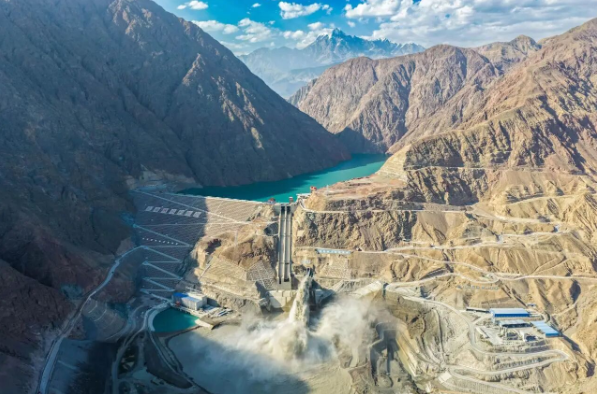
Construction teams worked through unfavourable local conditions, including dry and windy weather alongside unstable mountain slopes prone to landslides. Digital‑based management was deployed throughout equipment installation to secure ultra‑high‑precision lifting and fitting of key components. During trial‑run testing, core performance indicators such as unit vibration, shaft run‑out and bearing temperature remained within satisfactory ranges.
Once fully operational, the hydropower facility will deliver an annual power output of 1.893 billion kWh, enough to meet the yearly household electricity consumption of roughly 600 000 families. It will undertake peak‑regulation tasks for the power system across four southern Xinjiang prefectures and ease local power‑supply pressure. The reservoir will supply 3.42 billion cubic metres of ecological water annually to the Tarim River, relieving water shortages for more than 8 million mu of farmland within the Aksu River basin. Downstream river flood‑protection standards are upgraded from a 10‑year return‑period level to a 50‑year return‑period level, strengthening flood‑disaster prevention capacity and supporting the modernisation of agriculture across southern Xinjiang.
热门内容推荐