Maritime supply‑demand forum builds export corridors for Jiangsu manufacturing
According to Jiangsu Provincial State‑owned Assets Supervision and Administration Commission, representatives from port, shipping, cargo‑owning and freight‑forwarding enterprises across and beyond Jiangsu gathered in Nanjing for an international maritime supply‑demand matching forum. Fourteen cooperation projects were signed on‑site at the event, creating a face‑to‑face platform for ship operators and cargo owners.
Jiangsu ranks as a major province for manufacturing and open‑economy activities. In 2025, its gross regional product reached 14.24 trillion yuan with annual growth of 5.3 per cent. The share of manufacturing added‑value within provincial GDP stood at 33.5 per cent, the highest nationwide. Total foreign‑trade import and export volume hit 5.95 trillion yuan, placing the province second across the country, while utilised foreign‑investment figures maintained eight consecutive years in first position nationally.
Products including new‑energy equipment, construction machinery and automotive components are shipped to markets worldwide. Stable international sea‑borne transport directly shapes the global competitiveness of local manufacturers and safeguards industrial supply chains. The overseas development of XCMG illustrates this practical requirement, as the enterprise runs a global business network covering more than 190 countries and territories.
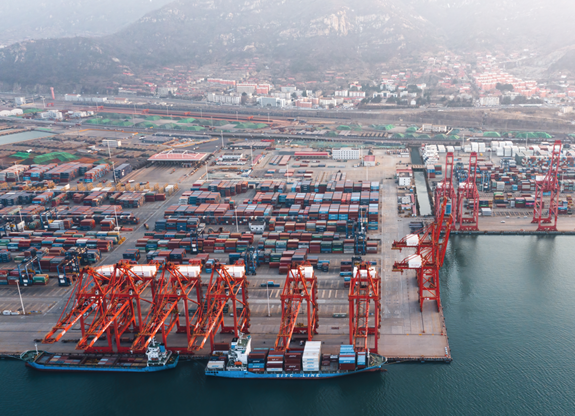
Jiangsu boasts substantial water‑transport infrastructure resources. Ports follow differentiated development patterns, combining seaport outward radiance, river‑sea transhipment at river harbours and inland‑port collection and distribution for hinterland regions. The province operates 606 berths for vessels of ten thousand tonnes or above, with an overall port handling capacity of 3.06 billion tonnes.
Ten ports exceed the 100‑million‑tonne throughput mark. In 2025, total cargo throughput reached 3.71 billion tonnes. Six Jiangsu facilities feature among the country’s top twenty ports by throughput. The 12.5‑metre deep‑water channel below Nanjing on the Yangtze is fully open, enabling 50 000‑tonne seagoing ships to sail directly to Nanjing. With 24 000 kilometres of total inland waterways and 2761 kilometres of grade‑three or higher watercourses, the province keeps leading national rankings for inland navigation. The ratio of total social logistics expenses to provincial GDP has dropped to 12.6 per cent.
Jiangsu Port Group acts as the integrated provincial operator for port assets. It manages 239 berths including 132 ten‑thousand‑tonne river‑side berths, running 223 shipping routes with more than 3000 monthly sailings. Its service footprint extends to over 100 countries and territories across four major outbound shipping corridors. The group broke the 1‑million‑TEU threshold for container throughput in 2024, before lifting overall cargo throughput past 600 million tonnes in 2025. It became the first inland‑river port operator nationwide to hit both milestones.
Multiple shipping and logistics enterprises are joining collaborative efforts to satisfy varied export requirements of local manufacturers. Jiangsu Port Group expands door‑to‑door end‑to‑end logistics and customised supply‑chain services, extending port‑side export capabilities deep into inland industrial zones. COSCO Shipping Lines draws on its substantial fleet and global route network for strengthened coordination. China Merchants Steamship delivers tailored heavy‑cargo logistics solutions for large‑scale equipment exports.
ZTE supplies technical support for intelligent port transformation while making use of maritime networks for local goods shipment. Sinotrans provides end‑to‑end supply‑chain services for a broad spectrum of industrial sectors. Zhongchu Zhiyun develops smart multimodal‑transport digital platforms to streamline online logistics workflows.
Participants at the Nanjing forum aim to develop robust international maritime corridors and reinforce the resilience of provincial maritime‑related supply chains. Jiangsu Port Group will press ahead with overseas service layout and deepen partnerships across the shipping sector.
By the first half of 2026, Jiangsu ran 102 international container shipping routes; nine new routes were added within the year, among which 28 are long‑distance ocean services linking directly to 38 countries and regions. Further work will focus on coordinated port development, regularised maritime matching events and improved policy support for foreign‑trade logistics.
热门内容推荐