World‑first Pterosaur‑themed Museum Opens in Xinjiang
According to Yunnan Provincial State‑owned Assets Supervision and Administration Commission, Hami Pterosaur Museum, the world’s first museum dedicated to pterosaurs, has officially opened to visitors. The construction work was completed by a subsidiary of Yunnan Construction and Investment Holding Group.
The museum sits within the core zone of Hami Pterosaur‑Yardang National Geopark, in the Gobi Yardang area of Wubao Town, Yizhou District, Hami. Covering 276.42 square kilometres, the geopark contains two distinctive sections, Pterosaur Eden and Dahai‑dao Yardang. The site earned national nature park status back in 2020. Following the opening of the museum, this remote desert area functions as a comprehensive cultural‑tourism base for pre‑historic life research, public science education and science‑fiction film production.
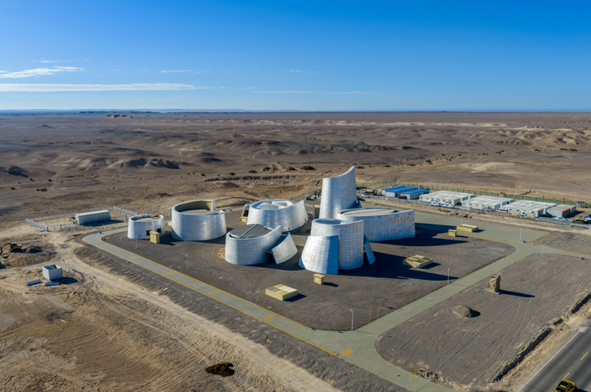
Designed around the “Spiral of Life” concept, the main building is sunk eight metres below the Gobi surface. Its total construction area reaches approximately 8,000 square metres, with an exhibition space of 4,600 square metres. Six scattered oval halls resemble a cluster of natural pterosaur eggs. The silvery‑white exterior blends smoothly into the surrounding desert landscape, forming a striking local landmark on the ancient Silk Road.
The construction site lies within the Shisanjianfang high‑wind zone, one of China’s harshest building locations. The region is regularly hit by gales of force‑13, with extreme temperature swings.
Winter lows drop to ‑22℃ while summer surface temperatures can exceed 70℃. Work formally commenced in September 2024. The construction team adjusted technical schemes and resolved multiple engineering difficulties, including long‑distance transportation of large‑size building components, material performance under extreme climate and accurate erection of irregular structures.
Optimised building technology delivers stable indoor temperatures all year round and improves resistance against strong winds and sand. Energy consumption for air‑conditioning and lighting has been reduced in comparison with conventional museum buildings. This geopark has been selected as one of the nation’s first typical cases for distinctive ecological tourism sites.
Industry assessments recognise that the museum’s hardware facilities and exhibition system satisfy top‑tier domestic standards, offering a high‑quality platform for palaeontological popularisation and research. The newly‑opened venue fills gaps in local cultural display provision. It establishes an integrated tourism framework combining museum‑based study tours, natural Yardang sightseeing and Silk Road heritage exploration, supporting the upgrading of local cultural and tourism industries.
热门内容推荐