Digital‑twin Technology Upgrades China’s South‑to‑North Water Diversion Eastern Route in Jiangsu
According to China News Service, the South‑to‑North Water Diversion represents a strategic inter‑basin water transfer scheme across China, with three planned routes running east, central and westwards to ease water shortages across northern regions.
The eastern route traverses Jiangsu, Shandong and Hebei provinces. By 10 August this year, the Jiangsu segment of this major infrastructure project had delivered almost 10 billion cubic metres of water out of the province, maintaining water quality steadily at Grade III national standards.
At Hongze Pumping Station, operations are managed by an in‑house “digital brain”, a sophisticated digital‑twin system embedded with intelligent water‑regulation models. While sluices and pump sets release flows, storage space is created for Hongze Lake and Luoma Lake to sustain pre‑flood water levels. Hydraulic potential generated during water discharge is also harnessed for green power generation.
Drawing on long‑term historical operating records, real‑time river‑section readings and fluctuating upstream and downstream water‑level data, the platform computes optimal operational parameters for pump units. Staff members may start or halt machinery and adjust impeller blade angles simply with mouse‑click commands.
Submerged sensors work alongside acoustic‑signature diagnostics and artificial‑intelligence monitoring models to keep continuous watch over the mechanical condition of pumping installations.
The intelligent digital platform cuts manual inspection workload substantially. Routine on‑site patrols previously took place every two hours, yet on‑site checks are now completed merely twice each day.
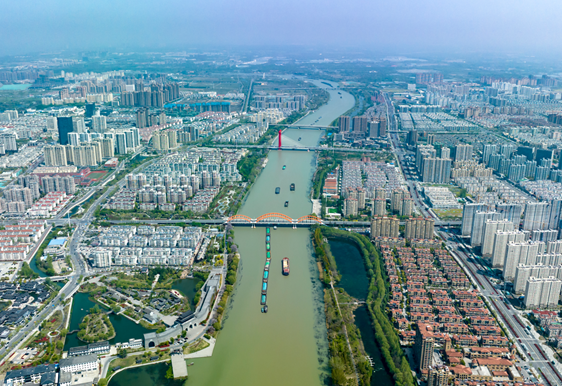
This type of digital‑brain infrastructure has been rolled‑out across all thirteen cascade pumping stations along the Jiangsu stretch, the source zone for the whole eastern water diversion route. Eight out of these thirteen pumping stations have adopted a remote centralised control regime with on‑site skeleton staffing.
During the current year, the Jiangsu phase of the eastern‑route first‑stage project has weathered successive typhoon events under unified dispatching from Jiangsu Provincial Department of Water Resources.
It has handled nearly 900 million cubic metres of water for drought relief, drainage and flood diversion, a volume broadly equivalent to the storage capacity of sixty West Lakes.
Response speeds for operational adjustments have improved markedly; dispatching workflows have been shortened from hour‑scale manual procedures down to minute‑scale online system execution.
Major national water‑network arteries are therefore shifting away from traditional manual scheduling towards smart, data‑driven regulation. Intelligent retrofits unlock combined benefits for farmland irrigation, ecological water replenishment and urban‑rural domestic water supplies, consolidating safeguards for regional water security.
Ongoing research and practical deployment of artificial‑intelligence‑assisted water transfer systems continue, alongside consistent safeguards for clean water supplies forwarded northwards. The project keeps delivering multiple local advantages within Jiangsu, covering drought resistance, flood drainage and inland waterway shipping.
热门内容推荐