Digital Infrastructure Takes Shape Along the Pinglu Canal as Telecom Towers Evolve into Smart‑Monitoring Nodes
According to Xinhua News Agency, the Pinglu Canal marks the first large‑scale river‑sea navigation waterway constructed in China since the founding of the People’s Republic of China. Serving as a core component for the Western Land‑Sea New Channel, the 134.2‑kilometre waterway runs southwards from Pingtang River Estuary in Hengzhou of Nanning, through Luwu Town in Lingshan County, Qinzhou, before reaching the Beibu Gulf along the Qinjiang River. Green grass covers the river‑bank slopes at Pingtang River Estuary, where the age‑old Yujiang waterway meets the newly excavated canal.
China Tower Guangxi Branch has integrated its work closely into the overall construction programme, setting‑up a dedicated multi‑party coordination mechanism. Regular liaison is maintained with the canal construction headquarters and major telecom operators, embedding communications infrastructure development right across the whole project lifecycle to deliver robust network services for the major waterway. Up to the present moment, working alongside telecom carriers, the branch has completed 54 newly‑built macro base stations alongside the canal corridor and carried out renovation work on another 12 existing sites. An indoor distributed antenna system has also been put in service at the Madao Hub. A three‑dimensional communications network now stretches across the water surface, river banks and key navigation hubs, laying solid digital foundations for this flagship project of the Western Land‑Sea New Channel.
Construction teams have tackled difficult geological conditions across the terrain characterised by scattered villages, extensive shorelines and mountainous stretches. At one site for the west base station near Luwu Town in Lingshan County, the original building scheme specified foundation piles extending nine metres downwards. When construction machinery hit heavily weathered rock layers on‑site, the initial plan proved unworkable. After thorough assessments of geological constraints, available construction machinery, safety standards and scheduled timelines, project staff held consultations with relevant operators and revised the design. A brand‑new 35‑metre tower built from advanced composite materials was adopted. The new‑style tower carries favourable structural performance with lighter self‑weight; it only requires foundation piles sunk to a depth of 7.1 metres and fits existing rotary‑drilling construction techniques perfectly. This innovative composite tower solution has subsequently been rolled‑out, with a further 26 identical towers erected at other points along the canal route.
Network deployment follows local conditions to satisfy two distinct sets of requirements: wide‑area radio coverage over open water stretches, together with deep signal penetration inside hub buildings. The project adopts a combined technical framework, pairing outdoor macro stations for broad‑range coverage with indoor distributed antenna systems for enclosed facilities. Under the intensive shared‑construction principle whereby one tower serves multiple mobile network operators, unified demand management helps prevent redundant infrastructure work, conserving land resources and cutting overall investment and operating expenditure. Site layouts take shipping lanes, construction work zones, roadside service areas and riparian ecological conservation fully into consideration. Customised solutions are worked out for every individual station location to resolve tricky coverage issues arising from the varied landscape.
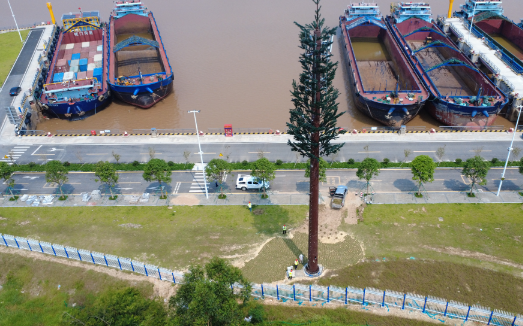
A bionic‑style communications tower has been erected at the Qinzhou waterside service area alongside the Pinglu Canal, balancing technical communications functions harmoniously with local waterside landscape features. Drone aerial surveys are deployed during the site‑surveying phase for outdoor macro‑station planning, speeding‑up site selection by delivering clear topographical information across river‑side terrain. Different tower variants are selected for different zones along the canal. Landscape‑sensitive river stretches make use of lower‑profile tower structures to preserve the visual environment, while reinforced tower models are deployed around harbour work sites and navigation zones. These reinforced installations stand up better to persistent humid conditions beside the water and improve disaster resistance for electronic hardware, delivering continuous radio coverage along the complete bank and water corridor.
The Madao Hub sits within Jiuzhou Town of Lingshan County and forms the first tier among the canal’s three navigation cascades. Signal reception inside the hub’s administrative and dispatch complex suffers interference caused by surrounding hills. Engineering teams have therefore delivered a bespoke dual‑route feeder indoor distribution solution for the building. Antenna positions and transmission paths are carefully mapped out in accordance with the building layout. Two multi‑system POI combining platforms and a total of twenty‑four internal coverage antennas have been deployed, enabling simultaneous shared network access for multiple telecom service providers. Uniform, continuous wireless signal coverage is now available throughout the hub administrative building.
Nearly two hundred communications towers erected on river‑banks are transforming from pure telecom facilities into physical carriers for the future smart canal. The opening of this new river‑sea artery unlocks fresh possibilities for digital transformation across the whole surrounding region. China Tower Guangxi Branch intends to capitalise on the elevated positioning of its base‑station sites and drive the functional upgrade from “communications towers” towards “digital towers”.
Leveraging both the high vantage‑point of tower structures and existing communications connectivity, these installations can be fitted with video capture units, radar sensors and internet‑of‑things monitoring equipment. Working together with space‑air‑ground integrated observation capabilities, they supply real‑time data, automated identification and situational awareness for vessel monitoring on shipping lanes, riparian ecological management and dike safety inspection tasks. These towers operate as digital sentinels distributed all along the canal, lifting overall management effectiveness for the waterway. The stable underlying communications infrastructure will also underpin subsequent smart shipping lane and intelligent port development, supporting digital upgrading for waterfront industries and cross‑border trade activities.
From overcoming construction obstacles for digital facilities and delivering reliable communications guarantees through to enabling smarter waterway governance in the years ahead, China Tower builds upon its core operational strengths and unlocks greater value from infrastructure‑sharing arrangements. Moving forward, the organisation will keep exercising its capacity as a key national player within digital‑infrastructure development and operation for projects along the Western Land‑Sea New Channel.
热门内容推荐