AI‑driven Smart Transformation Takes Centre‑Stage at 20th Yulin International Coal Expo
According to Securities Daily, the 20th Yulin International Coal and High‑end Energy & Chemical Industry Expo was recently held in Yulin, Shaanxi Province. The event bears witness to a sweeping shift within China’s coal sector, moving steadily from conventional resource exploitation towards intelligence and innovation.
At one exhibition stand, visitors put forward a string of safety‑related enquiries about underground workings. Within mere seconds, an industrial AI agent delivered precise feedback, completing analytical work that once demanded hours of manual processing. This intelligent system has been deeply integrated with existing mine operational platforms, furnishing end‑to‑end digital safety management spanning both surface installations and underground mining zones.
First launched back in 2006, the expo originated at a moment when Yulin’s raw coal output had just surpassed 100 million tonnes. Local energy‑chemical projects were springing up, and the industry required a dedicated platform for trade negotiations, investment promotion and technical exchanges. Over twenty years, what was once an event focused primarily on coal trading and project signing has evolved into a key vantage point for observing national energy‑sector upgrading.
Intelligent mining machinery has emerged as the main highlight across exhibition halls. Automated silo‑clearing devices remove the need for staff to enter coal bunkers, eradicating traditional hazards linked to dust accumulation, wall collapse and spontaneous coal combustion. Advanced integrated control systems for fully mechanised coal mining support 5G‑enabled industrial internet deployment. High‑capacity emulsion pump units are engineered for mega‑tonne underground mines, cutting overall equipment investment and routine maintenance expenditure. Fibre‑optic conveyor monitoring gear built with bone‑conduction technology captures faint mechanical vibration signals deep underground. Supported by AI acoustic‑pattern recognition algorithms, the equipment delivers reliable remote fault detection for underground belt transport systems.
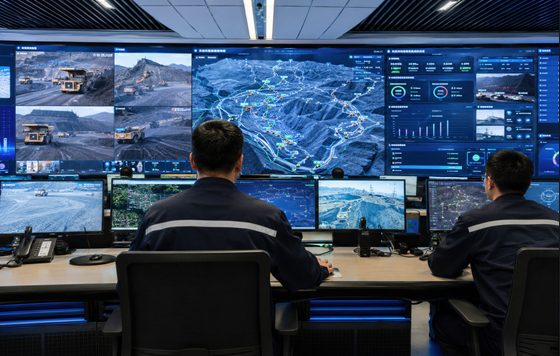
Early editions of the expo centred on basic mining gear and coal‑processing facilities. Intelligent systems and digital solutions now dominate display areas. Statistics released by the China National Coal Association show that 1,066 intelligent coal mines had been completed nationwide by the close of 2025, with more than 65 per cent of national coal output generated at these smart sites.
Yulin itself has pushed forward substantial upgrading work within its local mine fleet throughout the 14th Five‑Year Plan period. Seventy‑four coal mines have undergone intelligent retrofitting.
Local authorities are fostering an industrial ecosystem whereby practical operational scenarios stimulate technological adoption, which in turn nurtures new‑growth businesses. Several research institutes have set up dedicated programmes targeting smart‑mine research, while an industrial intelligent robot demonstration base was formally inaugurated in Shenmu during August this year.
A number of leading robot‑making enterprises have settled on‑site together with ongoing industrialisation schemes. The city is shifting its identity from a pure energy exporter into a provider of advanced coal‑mining technologies.
Beyond standalone automated machinery, large‑scale AI models and industrial intelligent agents are propelling the coal industry beyond simple automated execution towards autonomous decision‑making.
New‑generation industrial agents have been embedded right into live mine workflows rather than remaining as purely demonstrational concepts. National policy documents laid out within the 15th Five‑Year Plan for the coal sector call for expanded implementation of the “AI Plus” initiative.
They prioritise the development of coal‑specific large‑scale models and robot substitution for physically demanding, high‑risk underground roles. Contemporary AI frameworks reduce customisation workload for each individual mine, shortening deployment cycles considerably.
Industrial intelligent agents and robotic hardware are already deployed widely for safety surveillance, routine underground inspection, plant maintenance and production scheduling.
Official planning targets specify raising the proportion of output from intelligent coal mines to 75 per cent by 2030. The 15th Five‑Year timeframe will mark a vital phase for rolling out intelligence right across coal‑industry value chains, expanding unmanned operations at a majority of underground work sites. The two‑decade evolution of Yulin’s coal exposition mirrors the broader restructuring of China’s traditional energy industries.
Ongoing integration between artificial intelligence, industrial internet infrastructure and energy operations will continue to reshape coal production.
Modernised, digitally‑enhanced coal operations deliver solid backing for the construction of a new national energy framework and high‑quality growth across the real‑economy sphere.
热门内容推荐