China’s New Energy Storage Capacity Expands Rapidly, Diverse Technologies Advance in Parallel
According to China National Radio, China’s new energy storage sector maintains rapid growth through the year. Figures released by the National Energy Administration show that by the end of June, the installed capacity of commissioned new energy storage facilities nationwide stood at 153 gigawatts, with an energy capacity of 396 gigawatt-hours, marking a year-on-year rise of 61 per cent.
The utilisation performance of new energy storage across the country improves year by year. Equivalent operating hours reached 611 hours in 2023, 911 hours in 2024 and 1,195 hours in 2025, delivering tangible system regulation functions for the power network.
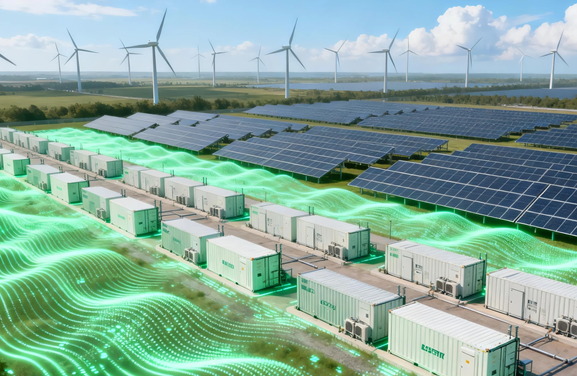
The installed volume of new energy storage in China surged more than 40 times during the 14th Five-Year Plan period, completing a historic transition from the early commercialisation phase to large-scale deployment. New energy storage will sustain robust growth throughout the 15th Five-Year Plan period, with projected additions of around 160 gigawatts of installed capacity.
Under the *15th Five-Year Plan for the Development of the New Power System*, national new energy storage capacity will hit 300 gigawatts by 2030, while grid-side standalone new energy storage capable of peak-load supply will reach 140 gigawatts.
A variety of technical pathways including lithium-ion batteries, sodium-ion batteries, compressed air energy storage, flywheel systems and molten salt storage are being rolled out at pace, forming a diversified and complementary industrial landscape.
The 300-megawatt compressed air energy storage stations in Yingcheng of Hubei and Feicheng of Shandong have entered operation, lifting the cumulative installed capacity of compressed air energy storage to 1.07 gigawatts, which accounts for nearly one per cent of total new energy storage capacity.
Compressed air energy storage boasts large-scale capability, long service life, high safety standards and strong grid support performance, making it one of the most promising technologies for long-duration energy storage. This segment will see accelerated expansion over the 15th Five-Year Plan period.
Diverse storage technologies will continue to be deployed across power systems, supporting the integration of variable renewable power and reinforcing the flexibility of the national electricity network.
热门内容推荐