First Cross‑border Land‑air Intermodal Logistics Trial Goes Operational Between Hengqin and Macao
According to CCTV.com, the launch ceremony for the pilot air‑cargo pallet‑building service of Macao International Airport’s pre‑positioned cargo terminal in Hengqin took place at the Nam Kwong (Hengqin) Logistics Centre on 26 August. Cargo for the maiden flight departed from the Nam Kwong (Hengqin) Logistics Centre in custom‑built aviation containers, cleared customs via Hengqin Port and reached Macao International Airport before being loaded onto a scheduled flight bound for Kuala Lumpur, Malaysia.
The milestone marks the full operational validation of China’s first cross‑border land‑air intermodal logistics project. The “via‑Hengqin‑Macao” logistics model moves from conceptual planning into practical deployment, delivering a complete process‑verified template for integrated Macao‑Hengqin air‑freight operations and laying solid foundations for scaled‑up commercial roll‑out.
Since April 2026, the Macao Special Administrative Region Government and the Executive Committee of the Guangdong‑Macao In‑depth Cooperation Zone in Hengqin have led progress on this pilot air‑cargo pallet‑building initiative under overall coordination. Leveraging its position as a central‑state‑owned enterprise based in Macao, Nam Kwong Group drives forward delivery work through its logistics subsidiary. The enterprise has built the first off‑site cargo terminal complying with Macao operational standards, fitted with X‑ray screening apparatus, lifting platforms and other core installations, and completed equipment delivery, installation and commissioning on‑site. Facilities for cross‑border e‑commerce inspection have been introduced, while premises for customs offices and central computer rooms are constructed to support the roll‑out of relevant business formats.
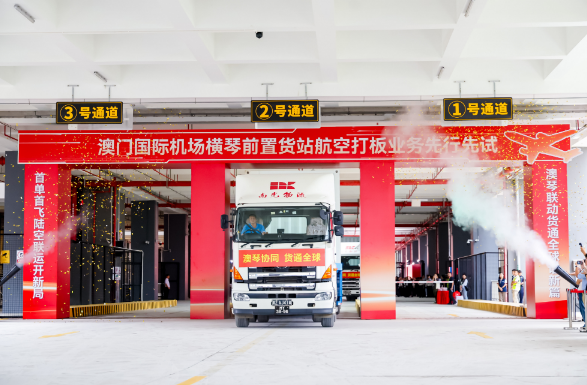
Custom‑engineered shipping containers are developed to suit Macao’s road conditions. Cross‑border transit routes are mapped out, and repeated real‑world vehicle trials are conducted across Macao and Hengqin to resolve bottlenecks in cross‑border cargo shuttling. Innovative customs regulatory frameworks are put into effect.
Drawing on China’s pioneering Guangdong‑Macao joint one‑stop clearance mechanism together with the facilitative Guangdong‑Macao cross‑border single‑lock measure, the new operating model delivers substantial improvements in clearance throughput and brings down overall logistics expenditure compared with previous arrangements.
Additional supporting infrastructure and regulatory refinements will continue to underpin the sustained expansion of this cross‑border logistics scheme. Operational workflows will undergo further optimisation to accommodate growing cargo volumes as more commercial consignments adopt this intermodal transport route.
热门内容推荐