Shanghai Unveils Combined Urban Renewal and Housing Development Plan for 15th Five‑Year Period
Shanghai has released its Plan for Urban Renewal and Housing Development under the 15th Five‑Year framework, marking the first occasion the city has drawn up a unified blueprint covering both urban‑renewal initiatives and housing development priorities.
The document sets concrete targets up to 2030, including upgrading no fewer than 150 office and commercial buildings and renovating 5 million square metres of commercial premises across the city. Whole‑chain improvements will apply to housing standards, design specifications, building materials, construction techniques and operational maintenance. Work will address real‑world residential concerns such as sound insulation, waterproofing, mould resistance and thermal performance, supporting the delivery of safe, comfortable, green and smart dwellings.
Major renovation programmes will move forward at pace to lift overall living conditions. Village‑in‑city renewal projects will all be launched by the end of 2026, with comprehensive environmental improvement completed for these sites. Pre‑construction preparation for full redevelopment will be finished by the close of 2027. For older residential blocks lacking complete supporting facilities, renovation of the remaining roughly 20 000 square metres of thin‑beam‑thin‑slab housing will aim for completion by 2026. Work will press ahead to retrofit non‑standard staff accommodation by 2030, alongside meaningful progress on lane‑style apartments and garden residences. A batch of urban‑renewal schemes will balance residents’ wellbeing and heritage protection.
Renovation scope for ageing residential compounds will expand further. Systematic repairs will cover public‑owned and former public‑housing estates, before extending gradually to mixed‑tenure and early‑phase commercial housing developments. Assessments will precede physical upgrading under phased implementation arrangements. Residents will take part in community self‑governance to preserve project outcomes. Independent renewal of older housing stock receives policy backing, alongside programmes for lift replacement and installation in multi‑storey blocks without lifts.
Under the framework for a new‑model real‑estate market, the city will foster larger, professional housing‑rental operators and build up a tiered regulatory system for the private‑rented sector. Housing supply will be calibrated against demographic shifts, household‑size changes and local conditions to shape appropriate volumes, spatial layouts and product mixes across administrative districts. More high‑quality, well‑equipped homes for owner‑occupier upgrades will come onto the market, with greater supply of prime residential land within central urban zones.
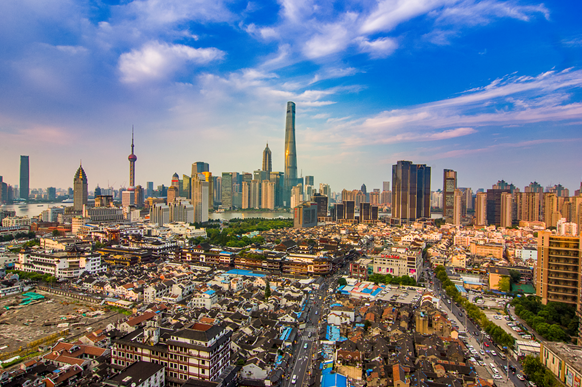
Existing built‑environment resources will deliver higher value through intensive‑growth approaches. Renewal works will roll out across key business precincts including Lujiazui, Hongqiao International Central Business District, Caohejing and Wujiaochang. Industrial land will undergo performance reviews, with classified disposal frameworks drawn up for low‑efficiency sites to accommodate strategic emerging industries and future‑oriented sectors. Around 75 square kilometres of under‑utilised industrial land will be unlocked for alternative uses. No fewer than 300 renewal projects will advance within priority zones such as the Second Façade of the Bund and Wusong Innovation City.
Public‑service provision will become better distributed and more accessible for residents. Underused built assets will be repurposed to fill gaps in local amenities. Feasibility studies will commence for refurbishment of sports venues including the Shanghai Municipal Sports Palace and Jiangwan Stadium. Age‑friendly waterfront spaces will be expanded along the Huangpu River and Suzhou Creek, alongside upgrades to ferry terminals and nearby rest facilities. One thousand new community senior‑care service stations will open, while barrier‑free modifications will be carried out on a minimum of 300 public‑transport stops.
Communities will gain integrated childcare, elderly‑care, health, cultural and retail amenities by reconfiguring vacant premises. Local public spaces, green belts and sanitation infrastructure will be refurbished to add more recreational zones. By the end of 2027, complete‑community coverage will reach 60 per cent across central districts and five new‑town areas. More than 15 distinctive complete communities will be newly built, together with 300 additional public‑service facilities. The share of mature large‑scale residential communities will rise above 80 per cent.
Ecological restoration forms an integral strand of the plan. Wetland habitats along rivers, lakes and coastal zones will receive protection and rehabilitation. A new round of park‑city construction will push ahead with the ring‑road ecological green belt. Riverside public access along the Huangpu River and Suzhou Creek will expand, with ecological corridors running perpendicular to the main waterways brought into connectivity. The total number of urban parks will surpass 1 600. An extra 100 hectares of public green space will be created along the Huangpu, and another 100 hectares of river‑front zones revitalised along the Suzhou Creek. A further 52 kilometres of continuous river‑front access will open on the Huangpu River system, covering four kilometres of main waterway and 48 kilometres of tributaries.
Improved coordinated drainage and flood‑defence infrastructure will support sponge‑city principles. Parks, plazas and underground spaces will incorporate flood‑retention features to strengthen urban flood resilience. Upgrades will proceed across municipal pipe‑networks under the city‑wide critical‑infrastructure safety programme. Energy and water‑supply installations will adopt more distributed layouts, with updated disaster‑resistance standards. Risk inspections will feed into renewal for ageing gas, water‑supply, drainage and power‑supply pipelines. By 2028, 300 kilometres of road sections will see overhead cables moved underground together with associated pole‑and‑cabinet remediation.
热门内容推荐