Green Computing: China Explores Two‑Way Integration Between Computing Power and Renewable Energy
According to Securities Daily reports, surging demand for artificial‑intelligence assistants, real‑time autonomous‑driving decision‑making and cloud‑based applications pushes computing power deeper into industries across the economy, bringing substantial growth in power consumption for digital infrastructure. Calculations from the China Academy of Information and Communications Technology show that China’s computing centres consumed 196 billion kilowatt‑hours of electricity in 2025. Consumption is set to exceed 700 billion kilowatt‑hours by 2030, accounting for more than 5 per cent of total national electricity use.
Against constraints on energy resources and the drive for low‑carbon transition, decarbonisation has become an indispensable requirement for the expansion of computing capacity. In July, China’s State Council released the 15th Five‑Year Carbon Peaking Action Plan. The document calls for improved energy‑saving and decarbonisation standards for computing facilities, energy‑efficiency retrofits for under‑performing sites, and phased elimination of outdated hardware to lift overall operational efficiency.
Industrial players are advancing multiple practical pathways, ranging from optimised computing‑resource allocation and coordinated computing‑power‑grid operation to higher uptake of renewable energy. New‑build intelligent computing hubs rise across grasslands in Ulanqab, Inner Mongolia. Benefiting from abundant wind and solar resources, low power costs and naturally cool climatic conditions, the city roughly 300 kilometres from Beijing has grown into a major national hub for intelligent computing. Under the national East‑to‑West Computing project, computing workloads generated in the Beijing‑Tianjin‑Hebei region are channelled westwards to these facilities via high‑speed data links.
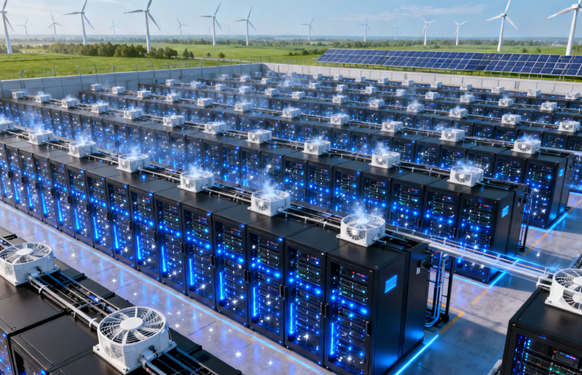
Within one large‑scale intelligent computing base in the Chahar Industrial Park, rows of servers process massive datasets before data flows back to eastern population centres over fibre‑optic networks. Spatial re‑distribution of national computing resources shifts suitable workloads west to energy‑rich regions, delivering greener and more resource‑efficient development.
Data centres have long carried a reputation for heavy electricity draw. Optimised geographical layout alone cannot fully resolve mounting energy pressure as computing demand keeps rising. Operators implement holistic low‑carbon designs spanning planning, construction and daily operation. Local wind‑solar resources and natural cooling are fully harnessed at site‑planning stages. High‑density hardware deployment and artificial‑intelligence‑driven thermal management boost natural‑cold‑source utilisation. On‑site substations support direct green‑power supply alongside integrated green‑electricity, energy‑storage and cold‑storage systems. The facility records a PUE (Power Usage Effectiveness) ratio below 1.2, with values closer to one indicating less energy wasted on non‑IT equipment.
Industry‑wide practices fall into four main dimensions. On the energy supply side, operators scale up renewable‑energy adoption through direct green‑power procurement and integrated source‑grid‑load‑storage frameworks. On cooling systems, liquid‑cooling technology cuts energy spent on thermal regulation. Infrastructure upgrades refine power‑supply architectures, hardware density and hot‑cold‑aisle layouts to drive PUE lower. Intelligent operation and waste‑heat recovery enable granular energy scheduling and resource recycling.
Regional authorities roll out differentiated regulatory frameworks. Large‑scale computing facilities emitting over 10 000 tonnes of carbon‑dioxide equivalent annually are incorporated into carbon‑trading mechanisms. Refined PUE supervision, tiered electricity pricing and efficiency‑oriented constraints push legacy data‑centre sites to complete energy‑saving upgrades.
Genuine zero‑carbon computing cannot rely purely on on‑site data‑centre optimisation. The sector is reshaping the historic one‑way relationship where power merely sustains computing hardware. New operational modes enable mutual interaction: power availability shapes computing scheduling, while flexible computing loads in turn support power‑system stability.
A domestic electricity‑carbon‑computing integrated co‑ordination platform has been developed to break down data silos across power‑system operation, carbon‑emission monitoring and computing‑load scheduling. Tariff signals and renewable‑energy output forecasts feed directly into computing‑task allocation decisions. Workloads are shifted to periods with low electricity tariffs and high renewable‑energy generation on a temporal basis. Spatially, tasks are reassigned towards locations rich in clean power resources. Integration with virtual‑power‑plant platforms relieves local grid stress during peak‑demand windows.
Field validation has been completed across Guangzhou, Suzhou and Gui’an. Operational costs for participating data centres fall by nearly 30 per cent while renewable‑energy absorption improves. Formal trial‑runs are scheduled to commence before the end of the calendar year. Artificial‑intelligence firms also deploy agent‑driven systems to refine energy management. One deployed agent solution within an artificial‑intelligence data centre is projected to deliver 24 000 tonnes of carbon reduction for every ten thousand units of computing power annually.
Technical evolution for coordinated computing‑power‑grid operation unfolds in three successive phases. Initial stages focus on pre‑emptive load regulation to mitigate sudden demand surges. A second phase pursues global optimisation through joint tuning of chillers, water pumps, cooling towers and CDU hardware to squeeze further efficiency gains from existing set‑ups. The final stage aligns cooling strategies with real‑time renewable‑energy output and supports cross‑region workload migration.
Structural bottlenecks remain despite advancing technical foundations. National Development and Reform Commission officials note persistent frictions within planning frameworks, pricing mechanisms and cross‑network integration. Monitoring and scheduling technologies for computing infrastructure also require further refinement.
The most visible industry‑wide pain point lies in mismatched construction timelines. Large‑scale intelligent‑computing facilities can be built and commissioned within eight to twelve months, yet supporting power‑grid infrastructure, renewable‑energy grid‑connection works and network planning frequently take three to five years. Such gaps can delay commissioning even when site‑build conditions are satisfied.
Green‑electricity trading mechanisms require further refinement. Although national green‑power transaction volumes expand steadily and green‑certificate systems mature, value generated by renewable‑energy supplies is not fully transmitted down to computing‑facility operators. Market‑oriented instruments including green‑power purchases and demand‑response programmes still need enhanced pricing and incentive frameworks to lower operational costs and lift renewable‑energy uptake. Inconsistent interfaces across disparate computing platforms create barriers for cross‑regional task scheduling and large‑scale collaborative deployment.
Realising low‑carbon computing depends less on isolated technical breakthroughs and more on deep co‑ordination across computing, energy and industrial supply chains. Deeper links must be forged between computing‑resource management, power‑system operation and carbon‑emission governance to drive systemic improvements throughout facility planning, energy procurement and real‑time scheduling.
Rapid expansion in artificial‑intelligence and large‑model services delivers substantial flexible computing loads for new‑type power systems. Data‑centre sites are evolving from passive high‑energy consumers into active participants supporting grid operation. Adjustable and relocatable computing capacity assists peak‑load balancing and boosts renewable‑energy integration, underpinning secure and efficient power‑system performance.
Competition within computing‑infrastructure development extends beyond server quantity and raw computing throughput. Operational capability will increasingly hinge on energy‑use efficiency and sustainable management. Superior capacity to utilise electrical resources underpins long‑term commercial viability for digital‑infrastructure operators.
热门内容推荐