China’s Railway Fixed-asset Investment Rises 1.8% in First Seven Months of 2026
According to Securities Daily, China’s railway sector delivered steady and high-quality infrastructure progress in the first seven months of 2026. Official figures from China State Railway Group Co., Ltd. show that national railway fixed-asset investment reached 440.6 billion yuan over the period, representing a year-on-year increase of 1.8%. The continuous expansion and upgrading of the modern railway infrastructure system has generated strong driving force for regional economic and social development.
Railway authorities have leveraged the long industrial chain, extensive coverage and prominent multiplier effects of railway investment to carry out planned and systematic infrastructure construction while improving the overall scale and quality of the national rail network. Multiple key railway projects across the country have achieved phased milestones since July. The Foshan Station of the Guangzhou-Zhanjiang high-speed railway has opened to traffic, cutting the fastest travel time between central Guangzhou and Foshan to 18 minutes. Full-line trial tests have commenced on the Xi’an-Ankang high-speed railway, while joint commissioning and testing has been successfully completed for the Harbin-Tieli-Yichun high-speed railway.
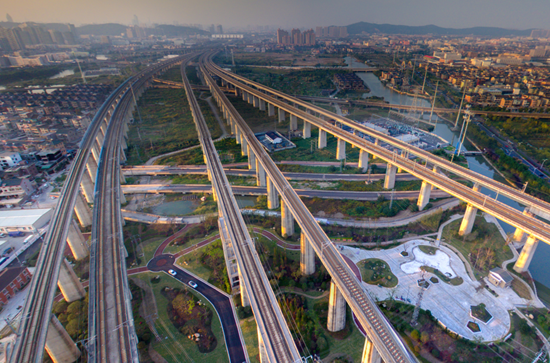
Major progress has also been made on several national strategic rail routes. The Shanxi section of the Xiongan-Xinzhou high-speed railway has finished track laying, and ballastless track construction has started on the Fenhu Tunnel of the Nantong-Ningbo high-speed railway. Full box girder erection has been completed for the Ankang-Chongqing section of the Xi’an-Chongqing high-speed railway, and the Caiyuanba Yangtze River railway tunnel on the Chongqing-Xiamen high-speed railway has been fully breakthrough.
Current railway investment priorities centre on three core areas: ultra-long cross-regional trunk corridors, complex geological control projects, and capacity expansion and upgrading of existing conventional-speed railways. Railway investment features long-term planning and stable operational rhythm, remaining unaffected by short-term quarterly data fluctuations. Industrial calculations indicate every 100 million yuan of railway investment consumes approximately 33,000 tonnes of steel and 200,000 tonnes of cement. The 440.6 billion yuan investment in the first seven months has driven the consumption of over 14.5 million tonnes of steel and 88 million tonnes of cement, stimulating growth in metallurgy, construction and equipment manufacturing industries.
Chinese authorities have prioritised the development of six key infrastructure networks covering water supply, new power grids, computing facilities, next-generation communication systems, urban underground pipelines and logistics networks. Preliminary estimates from the National Development and Reform Commission project total investment in these sectors will exceed 7 trillion yuan for the whole year. As the core backbone of the national logistics network, railways will sustain expanded infrastructure investment scales.
Railway network improvement directly boosts domestic logistics efficiency, serving as the primary carrier for bulk cargo and medium-to-long-distance transportation. Continuous investment will advance freight channel expansion, hub upgrading and multimodal transport integration. Railway investment typically follows a structural pattern of gradual acceleration throughout the year, with faster growth expected in the second half of 2026. Annual average railway fixed-asset investment is projected to stabilise at 800 billion yuan during the 15th Five-Year Plan period.
China State Railway Group will fully implement key railway construction tasks outlined in the 15th Five-Year Plan. It will coordinate the planning and development of new rail lines alongside capacity enhancement for conventional railways, unify planning, construction and operational management, and accelerate preliminary work for upcoming major projects. Optimised construction arrangements for ongoing schemes will steadily lift the quality and efficiency of railway investment, ensuring the completion of annual construction targets and supporting high-quality economic and social development.
热门内容推荐