Steel‑box Girder Closure Completed for Key Bridge on Shanghai‑Nanjing‑Hefei High‑Speed Railway
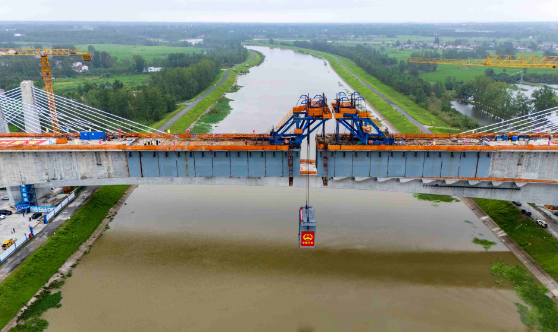
Nanjing, 13 August – The main steel‑box girder of the Chuhe River crossing section on the Liuhe Grand Bridge, part of the Shanghai‑Nanjing‑Hefei High‑Speed Railway, has been successfully closed. Built by China Railway Shanghai Engineering Bureau under China Railway Group Limited, this milestone unlocks critical access for follow‑up works including deck installation, ballast‑less track laying and four major electrical systems for rail transport.
Situated in Liuhe District of Nanjing, the main span adopts a hybrid steel‑concrete continuous rigid‑frame configuration. Side spans and pier‑top segments are constructed with prestressed concrete box girders, while the central span incorporates steel‑box girders. Steel‑concrete joint sections deliver rigid structural transition between two distinct materials. The design cuts dead‑load weight for this large‑span bridge and satisfies strict stiffness and geometric alignment standards required for 350‑km‑per‑hour ballast‑less high‑speed tracks.
During construction, building‑information‑modelling simulation tools and automated stress‑deformation monitoring systems ran continuously to record stress, deflection and temperature variations across concrete beams, steel‑concrete joints and steel girder segments. Construction teams refined steel‑girder assembly workflows, enforced tight dimensional controls for factory‑fabricated segments and on‑site fitting. Repeated checks were carried out on closure gaps, elevations and axial positions, with fine adjustments to girder attitudes securing precise joint alignment.
The Shanghai‑Nanjing‑Hefei High‑Speed Railway forms the eastern segment of the Shanghai‑Chongqing‑Chengdu Riverside High‑Speed Corridor, a vital component within China’s national eight‑vertical‑and‑eight‑horizontal high‑speed‑rail network. Stretching roughly 554 kilometres, the whole line is engineered for a top operating speed of 350 kilometres per hour.
Once fully completed, the route will deliver a brand‑new rapid transport link connecting the Shanghai Metropolitan Area, Nanjing Metropolitan Area and Hefei Metropolitan Area. It will reshape rail layouts across the Yangtze River basin and support high‑quality integrated development within the Yangtze River Delta.
Further civil‑engineering and system installation activities will proceed on the line. Final commissioning timelines will follow the progressive completion of sequential construction phases across the whole corridor.
热门内容推荐