Embodied‑intelligence robots shift from show‑floor stunts to real‑world factory deployment in China
Once known for acrobatic demonstrations at trade fairs, embodied‑intelligence robots are now taking up operational roles across China’s logistics and manufacturing sites. Total financing for China’s embodied‑intelligence sector exceeded 935 billion yuan in the first half of 2026, a five‑fold year‑on‑year rise, as hardware and software solutions move from technical display towards practical industrial deployment.
At Jianggao Land Export Centre under Guangzhou Postal District Centre, multiple embodied‑intelligence robots operate along mail‑sorting production lines. The machines carry out surface‑label recognition, parcel feeding and abnormal‑item sorting. After more than five‑months of iterative optimisation, each robot can process up to 1 200 parcels per hour with an accuracy rate above 95 per cent and sustain round‑the‑clock shifts. These repetitive, labour‑intensive posts place heavy physical demands on human staff. Operational targets have been set to lift throughput to 1 400 parcels per hour by the fourth quarter of 2026 and reach 1 600 parcels per hour in the first quarter of next year. Teams are also exploring extended use‑cases for loading, unloading and warehouse‑distribution workflows.
Similar roll‑outs are underway in manufacturing facilities. Within an automotive plant in Beijing Yizhuang, embodied‑intelligence robots perform precise tasks including component picking, flexible‑cover fitting and container folding alongside production lines, recording a 98 per cent success rate at individual workstations. Deployment has expanded across logistics, automotive assembly, consumer‑electronics and power‑battery production lines through 2026.
Growing venture‑capital backing reflects shifting market priorities. Investment institutions now place greater weight on engineering delivery capacity, scalable deployment and consistent order‑winning performance, rather than conceptual innovation alone. The industry is moving past early‑stage technical validation and entering commercial‑application phases. Industry frameworks divide market penetration into three sequential tiers: industrial‑site roll‑out as the first stage, followed by commercial‑service adoption, and household‑consumer applications as the final phase.
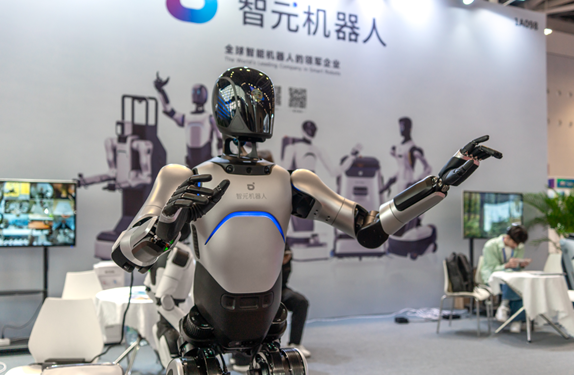
Scarcity of real‑world physical‑interaction data creates substantial technical barriers for embodied‑intelligence development. Unlike large‑language models trained on publicly‑available online text corpora, these robots must learn physical‑world mechanics such as object‑gripping techniques, force modulation and dynamic environmental feedback. Factory‑generated operational data is largely proprietary and rarely shared publicly.
Chinese technology firms are building so‑called “data flywheels” to resolve this bottleneck. Robots complete practical tasks within live working environments, generating fresh operational datasets which feed back into algorithm improvements. Enhanced performance enables deployment across additional scenarios, yielding further streams of real‑world data and driving continuous technical upgrades. Practitioners stress that genuine technical value emerges from practical operational requirements rather than isolated laboratory tests.
Policy measures support large‑scale industrial adoption. In June 2026, the Ministry of Industry and Information Technology and the State‑owned Assets Supervision and Administration Commission jointly launched a special practical‑training initiative for humanoid and embodied‑intelligence robots. The programme targets over one hundred high‑value application scenarios and supports deployment at the ten‑thousand‑unit scale by the end of 2026.
The industry is undergoing a fundamental paradigm shift. Competition no longer centres on spectacular exhibition‑hall movements, but on stable, reliable operational performance. The substantial capital inflows signal a tangible commercial pathway: real‑world settings generate authentic operational data, which strengthens robotic capabilities and unlocks further application scenarios. Sustained rotation of this data flywheel transforms exhibition prototypes into productive industrial assets. Companies that successfully establish closed‑loop data cycles within live industrial environments will secure competitive advantages amid the current practical‑deployment phase.
热门内容推荐