Shanghai Port Delivers Robust H1 2026 Results with Green Shipping and Smart Upgrades
As the operator of the world’s largest container port, Shanghai International Port Group (SIPG) has posted solid operational growth in the first half of 2026 amid intensifying global port competition and lingering external market uncertainties. According to official operational data, the group handled 28.737 million TEUs of container throughput at its home ports in the first six months, representing a year-on-year increase of 6.2 percent. Total cargo throughput reached 304.78 million tonnes, rising 2.7 percent from the same period last year.
SIPG has built a complete local industrial loop for green shipping fuel supply, forming a closed industrial system covering local production, warehousing and bunkering services in Shanghai. Within the framework of the Shanghai International Shipping Green Bunkering Center construction, the group’s energy service vessel successfully completed ship-to-ship bunkering operations for the methanol-fueled pure car and truck carrier Arctic Tern, operated by global ro-ro shipping firm EUKOR. The operation supplied 2,824 tonnes of locally produced green methanol sourced entirely from Shanghai’s domestic industrial supply chain.
The whole-process domestic model realises local production, local storage and local bunkering of green marine fuel, establishing Shanghai Port as a core hub within the global low-carbon shipping supply system. It marks the first large-scale supply of Shanghai-produced green methanol to an international leading ro-ro shipping enterprise, creating a replicable and promotable operational model for global maritime decarbonisation.
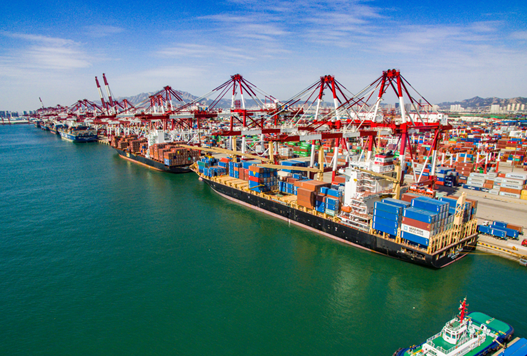
The port continues to consolidate its hardware infrastructure and expand long-term capacity potential through key phased projects. The northern Xiaoyangshan operation zone serves as a critical incremental capacity carrier for Shanghai Port, functioning not only as an advanced container terminal but also as a strategic fulcrum for the outward expansion of Shanghai’s international shipping capabilities toward open seas. Upon full completion, the new zone will form functional complementarity with existing Yangshan port areas and strengthen the hub radiation capabilities of Shanghai Port across the Yangtze River Delta and Northeast Asia.
The second-phase renovation project of Luojing Container Terminal is steadily advancing following the successful transformation of the first phase from traditional bulk cargo terminals to automated container terminals. Adhering to integrated intelligent and low-carbon development concepts, the second-phase upgrade will further release container collection and distribution efficiency at the Huangpu River estuary.
The synchronous advancement of the two major projects optimises operational efficiency for near-sea and domestic trade shipping routes, laying a solid foundation for sustained capacity growth and diversified service upgrading of Shanghai Port.
SIPG will maintain integrated and coordinated operational strategies across all port areas in subsequent development stages. Continued optimisation of operational efficiency, green industrial layout and intelligent upgrading will sustain the port’s leading position in global container throughput, delivering stronger foundational support for the high-quality development of Shanghai International Shipping Center.
热门内容推荐